Cards in Magic & Mentalism: page 43
Products
Emergency Prediction
Raphaël Czaja
The magician can't find the spectator's card but his prediction can.
In short:
The spectator cuts to a card, removes it from the deck and remembers it. Then, the magician shuffles the deck and divides it into two halves. The spectator shuffles both parts, loses his selection between them, and shuffles even more. At the end, the magician runs through the deck and removes a card, but it is not the spectator's. Fortunately, the magician has an "emergency out", a message on a piece of paper inside a red envelope, in full view from the start. The spectator reads it out loud:
"If I was...
Embellished + Covert Assembly (bundle)
Peter Duffie
Two download videos by Peter Duffie for one low price. Both are reworked items. Embellished is a reworked Valediction, and Covert Assembly is a rework of Pocket Assembly.
Embellished
Peter Duffie
- Great finish to any routine.
- This is a reworked version of "Valediction".
- Easy one-time Preparation.
Elmsley Flushtration Count
Allan Ackerman
From John Bannon's book Smoke and Mirrors here is another 2-4-4 count - a variation of Larry Becker's Mirage Count.
runtime: 1min 39s
Elmsley Count or Ghost Count
Allan Ackerman
The Elmsley count, developed by Alex Elmsley, is probably the easiest and most deceptive count there is. Allan calls it 'the monster move of the 20th century'. Countless of routines have been devised using this move. The most famous of all is Twisting the Aces by Dai Vernon.
runtime: 2min 43s
Elliott's Last Legacy
James William Elliott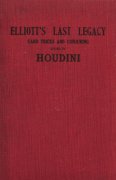
Elliott was a very popular magician. Particularly some of his card effects were considered best of its kind. Nobody knew the secrets to some of Elliott's tricks. People waited impatiently for the release of this book. But it was met with some disappointment that not all of Elliott's tricks were described. We do not know which tricks these critics mean. The reason might well be that Elliott died before he could finish his book. Burgess and Houdini had to collect Elliott's notes and fill in some of the missing explanations. However, Elliott and Houdini believed that all the material in...
Eliminators
Ulysses Frederick Grant
This is a great little booklet where U.F. Grant teaches three non-sleight replacement methods for
- Pass
- Force
- Palm
- Switch
1st edition 1943, 1st digital edition 2017, 4 pages.
Elevation Ovations
Jon Racherbaumer
Although Marlo is generally credited with the Elevator plot, analysis of the action steps taken in the Four Burglars, Jacob's Ladder, and Marlo's Penetration exhibit procedural similarities and could be presented as "elevating tricks" if accompanying patter expressed the "elevator" analogy. As far as the "elevator" trope is concerned, we can credit Bill Simon for naming rights.
Table of Contents
- Part One: The Burglazing Beginning
- Introduction
- Gibson Puts Perps On Parade
- Rising Crime / Daryl Martinez
- Rising Robbers / Jon Racherbaumer
- Four Burglas / Jerry Mentzer
- Mystery...
Elective One-Eyed Jacks
Ian Baxter
That popular card plot One-Eyed Jack Sandwich is given a new lease of life here, with the assisting spectator being asked where the magic is to take place – within the deck or out of it. Themed after a 1930’s classic The Charmed Watch, this smooth handling is sure to delight the most fastidious card man.
The One-Eyed Jack Sandwich theme was popularized by Harry Lorayne. However, it was none other than the Australian Charles Wicks who started the ball rolling, with his contribution The Charmed Watch appearing in The Magic Wand journal over eighty years ago. Ian's streamlined version keeps within the guidelines of...
Ekaf
Maciej Dziegielewski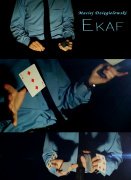
"I'm not a big fan of twirls flourishes but the way Maciej does them it is really beautiful!" - Dominik Mastrianni
"Very nice combination of classic and original sleights. Nicely flowing flourish overall." - Alexander Melnik (Decemberboys)
"cool stuff dude :)" - Sebastian Skowron
"I like the card transpo-thing. :)" - Jonas Haglund
Ekaf is 'fake' reversed. The reason for this title is that these card flourishes and manipulations look stunning and difficult, but are for the most part relatively easy to do. It is therefore the ideal entry routine for somebody to get into flourishes,...
Einstein's 5-3 Principle
Dustin Marks
Effect: Three spectators secretly distribute three "Word Number Cards" (One, Two, Three) among themselves. They then select from five "Red Numeral Cards" (10,11,12,13,14) based on the magician's ambiguous instructions. Without asking any questions or touching any of the spectators' cards, the magicians know the specific Word Number Card and Red Numeral Card held by each spectator, plus the sum of their two cards when added together.
Description: If you have never heard of the 5/3 principle, you are going to be amazed. If you have heard of it and think it is a cute puzzle, you were right. ...
Effortless Card Magic
Peter Duffie
Effortless is probably just as appropriate or misleading as self-working. It doesn't mean that these tricks don't require any effort on your side. You have to read the descriptions, remember the sequence of actions and perform the act - entertain, which in my book is neither self-working nor effortless. But what these terms try to convey is that you will not need to master difficult moves or finger-breaking sleights to perform these effects. And they are very good effects. Often an 'effortless' trick can be performed to greater effect because the performer can pay more attention to audience...
Effects with the Card Index
Mark Weston
The card index is an item that should be in the accessory department of every working magician; once the method of working has been grasped and the necessary practice acquired, a new field of card magic miracle effects is open to the practical performer.
Table of Contents
- Setting The Indexes
- The Method Of Stacking
- Actual Working
- Position Of Indexes In The Pockets
- The Cards From The Pocket
- The Twins
- Transposed Aces
- Lone Ranger
- The Invisible Card
- The Last Card
- Pairs
- The Card In The Pocket
- Six Cards In The Hat
- Card Stab
- Card In Wallet
- Various Other Uses For The Index
...
Effects with Cards 2
Arthur Buckley
This is the second of Arthur Buckley's problems: The Burglar
- Effect, Brief Presentation and Patter
- Sleights Necessary to Perform the Burglar (crimp, two-handed pass, Down's change, a secret removal, riffle shift)
- Details for Learning Sleights
- Rehearse Problem
1st edition 1921, 10 pages; 1st digital edition 2017, 9 pages.
Effects with Cards 1
Arthur Buckley
Arthur Buckley, one of the great sleight-of-hand artists with cards and coins, has written a series of twelve problems. This booklet is number one. It is illustrated by Harlan Tarbell and edited by Gus Moford. Dariel Fitzkee later reprinted these twelve problems in The Card Expert Entertains but used different inferior illustrations. If you have ever heard something about the 'Buckley card problems' this is one of them.
1st edition, August 1921, Magic Products Company, Chicago; 10 pages.
Number One - A Triple Climax
- Effect, Brief Presentation and Patter.
- Sleights Necessary to Performing the Triple Climax.
- The...
Effects with Business Cards
Gerard Zitta
Imagine you are anywhere but on stage, and you are unprepared. Somebody asks you to do a 'magic trick' (yeah, they know who you are!). You answer you would like to, but you have nothing with you, but a pen and a few business cards. You take out your business card holder or box, and you start amazing your audience.
Now, imagine you would take a deck of cards. It would be all different … Nobody would believe you are unprepared!
This ebook is a compendium of Gerard Zitta's effects, that can be done with business cards. They all 'look' impromptu, and most of them are indeed impromptu...
Effective Card Routines
Aldo Colombini
Here you have ten strong routines by Aldo Colombini using special cards (easily found).
CONTENTS:
- ADD-ACADABRA: Two predictions. After a couple of gags, the predictions are shown correct.
- TURNING POINT: A card is reversed in the deck. Four double-blank cards are shown and one is selected. This card now bears the image of the chosen card which is now blank.
- CHIP-CHIP HURRAY: You show seven cards and two poker chips. One card is selected and the same image appears on one of the chips. The other cards are all blank.
- MICKEY FINN: One card is selected among six. This card has a poison sign...
Effective Card Magic
William (Bill) Simon
This book was edited by Jean Hugard and illustrated by Stanley Jaks.
Martin Gardner had the following to say:
"Bill Simon has achieved an astonishing mastery of the medium. His mind is constantly probing for new and subtler moves, and bold effects which break fresh paths in the card jungle. In this book he has given generously the fruits of his thinking and experience. The result is a book almost certain to become one of the basic texts of modem card conjuring."
This ebook covers many entertaining plots, novel sleights, shuffles and fancy cuts as well as...
Edward Marlo's Think Ace
Jon Racherbaumer
The Think Ace effect is a hybrid, reduced to a packet trick. It was inspired by an effect described to Marlo by Bill Simon in 1955.
Table of Contents
- Introduction
- Beginnings
- Touch Turn
- Named Reverse
- Think Ace
- Gaffed Think Ace
- Tributaries
- Swindle Think Ace
- Technicolor Think Ace
- Four-Card Technicolor Thought Number One
- Four-Card Think Ace Number Two
- More Four-Card Technicolor Thoughts
- Cased-In Technicolor Thought
- Tabled Think Ace
- Spread Think Ace
- Contingency Aces
- Bold B'wave
- Unanswered Letters
1st edition 1993, PDF 35 pages.
Edward Marlo's Full Tilt
Jon Racherbaumer
There was a time when the Tilt, or Depth Illusion, was a top-secret technique known only to a few select insiders. The history of this move is somewhat murky, but most credit Dai Vernon with its invention. Marlo claimed he came up with it independently, which I find plausible. Regardless of who first had the idea, the Tilt is a wonderful deception. Over the years, refinements and subtleties have been added by several cardmen. Today, the Tilt is one of the core techniques most card magicians have in their arsenal.
The concept of the Tilt is the following: A card is apparently...
Edward Marlo's Compleat Devilish Miracle
Edward Marlo & Jon Racherbaumer
A mysterious, baffling, entertaining, eye-appealing transposition of two selected cards.
A selected card vanishes, reappears, vanishes, and transposes itself with another previously selected card. This PDF includes the original manuscript, plus all the refinements and methods Marlo added over the years.
More detailed effect description:
Two spectators freely select cards from a shuffled deck. The selections are returned to the deck, which is mixed and cut. The cardician removes five cards. Each one is shown and tabled, then he asks, "Did anyone see their card?" One of the spectator...
Eddie's Dumbfounders with Cards
Eddie Joseph
No skill - no sleights - no moves
- Introduction
- The "Tobba" Mystery
- Who Knows the Card?
- Incredulously True
- Two Secret Thoughts
- Memory Phenomenal
- Over the Wire
- The Mystic Queen
- One-Eye Joe
- The Expert Cuts
- Can You See Your Card?
From the introduction:
Now comes the question — Why bring all this in here? Merely to stress a point. ANY TRICK WILL BE CONSIDERED AN APPARENT MIRACLE WHEN THE CAUSE EVADES US. Pages and pages have been written in an attempt to define Magic. I will give it to you in FIVE words, "THE ART OF CONCEALING THE CAUSE". The better you are able to conceal the...
Ed Marlo Confidential
Edward Marlo
A wonderful look at the life and times of Ed Marlo, with vintage, rare, underground footage. Called "one of the most important tapes of the Millennium" by Matt Field, this tape lets you get to know the real Ed Marlo.
1st edition 2000, length 1h
Easy Touch
Ian Baxter
Paul Curry is a name that captures the attention of magicians everywhere, thanks to his famous card trick Out Of This World. Invented by Curry back in 1942, it remains an absolute staple for the self-working card enthusiast.
Not to be overlooked, however, was Curry's initial blast onto the magic scene five years earlier. Launched in 1937, Touch was (and still is) by any measure, a superlative card mystery. Over the years, variations from the experts have appeared in print. Some of these have been downright disappointing because they have been far too complicated, or like Curry's original, the burden...