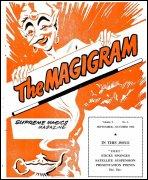
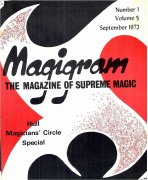
I recently binge-watched the entire seven seasons of the TV show Mad Men. If you're not familiar, Mad Men is an award-winning period drama set in the glamorous world of New York’s Madison Avenue advertising agencies during the 1960s and early 1970s. After finishing the series, I became curious about what magic-trick advertisements looked like during that era. So I plunked down $3.00 and downloaded Magigram Volume 2 (Sep 1968 - Aug 1970).
Much to my surprise, the 800+pages of Magigram were filled with as much drinking, sexism, racism, and homophobia as there was an entire season of the TV show. Don't get me wrong. I’m no namby-pamby, bra-burning male feminist, or an uber-sensitive college soy boy who’s here to whine about the sins of our spiritual fathers' pasts. Far from it.
I always felt that magic and illusion were mostly disconnected from the outside world—focused solely on secrets and sleights while turning a blind eye to the cultural and political trends of the time. The art seemed content to endlessly draw from its rich historic past, never progressing much beyond the Houdini or Blackstone eras, willfully tucked away in a charming fantasy Neverland.
But now I stand corrected.
One advertisement that jumped out at me on page 543 was for a product called the Sex Cards. Here’s the ad copy verbatim:
Here’s a great gag from Tom Fitzgerald. We had a sell-out of these some time ago at a convention, but we are now pleased that they’re back in stock again.
The specialty printed card says: “If you are in the mood for sex, keep this card and smile. If you’re not in the mood, tear this card up.” You hand the card to any attractive female. The gag comes if they try to tear the card up … because they can’t! These cards happen to look like flimsy paper ones but are in fact printed on a special material which is completely untearable. What a gag! What a laugh! What can you lose! What can you gain!?!
Oh my, how times have changed! There was even an ad for a product called “Nudist Cards For Children.” WTF! Much of the humor here has aged like fine milk, and after a while the women-bashing jokes left a sour taste in my mouth. I’m guessing now that failed Andy Warhol assassin Valerie Solanas wrote her 1967 SCUM manifesto after witnessing a bad magic act.
If you're looking for new tricks, I don’t have much to offer—the magazine was filled with advertisements and presentations for apparatus-style magic, which isn’t really my thing. I find props like dove pans to be “strictly for the birds” (pun intended). Honestly, the pages of Magigram were overflowing with ads for dove pans, as well as books and encyclopedias dedicated to them. After a while, I wasn’t sure if I was reading a magic magazine or a small game cookbook. By the end, I had the sudden urge to go into the kitchen and roast a squab.
While much of the material in Magigram felt stale and past its prime—like discount meat at Walmart—it still had a few valuable gems, some wheat hidden amongst the chaff.
What caught my attention most were the hand-drawn pen-and-ink illustrations, especially the small, standalone spot illustrations scattered throughout the magazine’s pages. Many were rough and crude, with a raw, naïve style I found utterly charming—so different from the cold, soulless AI-generated graphics seen today in online publications like VANISH or Magicseen. Unfortunately, there were no credits, so I have no idea who these artists were—which is a real shame.
A series of articles by a young Billy McComb, “At Homb With McComb,” also offered advice on becoming a professional magician. As someone who still struggles as a semi-unprofessional ‘ham & egger,’ I found much of his advice a bit over my head. Still, Billy McComb is on my short list of favorite magicians, and I found his articles a welcome addition.
All in all, reading these old issues of Magigram was a treat. For just $3.00, I was able to step back in time—like an episode of Mad Men—to a bygone era of suave, tuxedo-clad nightclub magicians like Channing Pollock, as well as socially awkward tricksters intent on sexually harassing their female audience members.
That said, I don’t believe we need to “cancel” this material or erase it from history. As magicians, amateur or professional, we’re part of a lineage that stretches back to prehistoric times, and it would be a shame to dismiss this material as insignificant or “problematic” simply because it’s tacky or cringe-inducing.