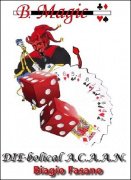
This is a doubly magical effect in which a spectator selects a card from the deck - twice - based on the number resulting from the roll of two imaginary dice.
It's an effect in which the magician shows the entire deck to the audience while removing the two Jokers, shuffes it, and has a spectator cut the deck and complete - over and over again, as many times as the spectator wishes. When satisfied, the magician will stack a small pile of face-down cards, setting aside the rest of the deck. The spectator will imagine rolling two six-sided dice and mentally read the total (from 2 to 12). He will take the cards from that small pile and stack the number of cards he has chosen.
The last card, on which he has decided to stop, and the one before it (at the top of the set-aside stack) will determine a new chosen card, consisting of the value of one and the suit of the previous one.
The face-down cards remaining in his hand from that small stack will determine the number. Incredibly, by counting the cards from the rest of the deck - still held face down - up to that number, and then turning over the next card, the spectator will find the very card he chose!
But the surprise isn't over yet: by switching the positions of the two "generating" cards, the magician will show how the one that previously indicated the value can now indicate the suit, and, conversely, how the second card can determine the value of a new card; finally, by counting - this time - the pile of other cards that he had stacked face-down on the table before stopping, a new number will be determined.
Well, the spectator will be asked to turn the deck face up and count from the top of the exposed deck to find the card that comes next to the number - and will find the very second card he chose right there in his hands!
Strengths:
- The effect is incredibly fully automatic.
- The magic can happen right in the spectators' hands.
- The deck can be easily controlled.
- All the cards are in the deck, and there are no duplicates.
1st edition 2026, PDF 9 pages.
word count: 3456 which is equivalent to 13 standard pages of text