Video clips (download) in Magic & Mentalism: page 45
Authors
Products
Dancing Handkerchief
Brick Tilley
Four methods of this classic illusion, suitable for close-up, parlour or stage. Both DIY and sleight of hand to suit your needs and desires. Can be done surrounded. No threads, magnets, or hookups. Simple construction. Add the effect of giving life to an inanimate object to your performances for a real crowd-pleaser. Highly recommended for children.
Cover art: House of Horrors, Coney Island, 1961, Diane Arbus
1st edition 2025, video 1:57.
Impromptu Cut Four Aces
Miku W.
A fully impromptu performance: you borrow a deck, let the spectator give it a thorough shuffle, no cull, no crimp, then claim you'll memorize the positions of the four Aces. You riffle down the deck and ultimately cut cleanly to all four Aces. A full performance is shown in the demo video.
Before you purchase this tutorial, here are a few things to help you decide whether it suits you.
1. Effects of this nature require a lot of practice. My handling strips away unnecessary difficulty and simplifies moves that are normally quite demanding, but it still requires solid work. This is definitely...
Easy and Nice
Peter Pellikaan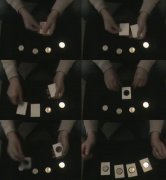
Four blank cards, shown from both sides, suddenly have big holes cut through their centers.
1st edition 2025, video 4:25.
A Number For Fast Cut
Miku W.
This is my adaptation of Marlo's A Number for Fast Company. I've reworked it to be completely impromptu, finishing with a clean, accurate cut to the spectator's selection.
The spectator shuffles the deck freely, chooses any card, and returns it before shuffling again. The performer then names the exact position of the selection and says, "If I know the position of your card, I should be able to cut straight to it." He then lifts off a packet - matching the number just named - and the final card of that packet is the spectator's selection. Full performance in the demo video. ...
Flash Aces Sandwich
Miku W.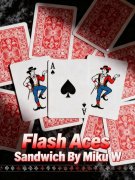
Two Jokers produce two Aces in the middle, and finally, the Jokers transform into the remaining two Aces. A classic effect with a unique and visual handling. Complete performance in the video.
Performance transcript:
- For this next trick you need two cards.
- Between two cards there's nothing there.
- 3 2 1 discover
- There is an extra ace in the middle of the two ghost cards.
- Two ghost cards.
- OK.
- Continue 3 2 1
- Converted the second a
- These two cards, shake them a little bit.
- You will find these two ghost cards.
- It automatically becomes the other two A's.
1st edition 2025,...
Minimal Colossal
Pablo Amirá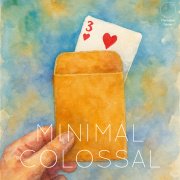
Minimal Colossal is one of my favorite approaches from the neoclassic Kolossal Killer from Kenton Knepper.
- One envelope in full view
- Any playing card is named through a simple and flowing procedure
- One card, completely correct
In this video you will learn the basic secrets, a simple and effective use of the classic OBO principle (thanks Kenton for your permission and blessing), the construction of the special envelope (DIY, very simple to make) and much more. You will learn variations and extra uses and ideas using the methods at play.
- 100% practical for all situations ...
Swing Cut Four AK
Miku W.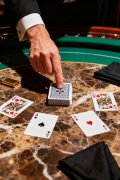
This is my direct cut to the four Aces and four Kings routine. It's simple and easy to learn, using only basic card handling techniques. No crimp, no estimation needed. Full performance in the video.
1st edition 2025, video 4:29
Quadruple Elevator
Miku W.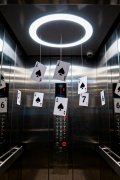
An adaptation of a classic card routine - the Spades 1, 2, 3, and 4 travel between the top and bottom of the deck, finally gathering together on top. Just when you think it's over - no, the magic has only begun. The Spades 5, 6, 7, and 8 appear on top of the deck, the Spades 9, 10, J, and Q appear on the bottom, and the final Spade King rises to the very top of the deck. For full details, see the performance video.
Performance transcript:
- Imagine the deck as a building, with each card representing a floor.
- The Ace of Spades travels from the bottom to the top.
- The Two of Spades goes...
Autumn Leaves
Pablo Amirá
Imagine a meaningful and memorable piece of mentalism using just a deck of cards.
- 100% impromptu
- No boring storytelling
- No gimmicks
- Simple sleights
- Useful for all situations
Welcome to Autumn Leaves, a piece that I originally released at the Emergency Act, part of my professional repertoire that can serve you well as a fascinating card prediction and a reminder of the power of child-like awe.
Every magician and mentalist can predict a card, but be the one who creates a beautiful precognition.
1st edition 2025, video 15:15.
Sandwiches and Collectors
Miku W.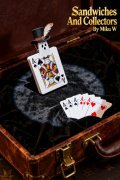
Sandwich and Collectors are two of my favorite card effects and the ones I've studied the most. This is my original routine combining both effects.
The spectator selects a card, returns it to the deck, and the deck is shuffled. The magician cuts the two Jokers and four Aces into the center. When the deck is spread again, the two Jokers are found sandwiching the spectator's selection, while the four Aces have collected the other three cards of the same value. A pure sleight-of-hand routine with no difficult moves.
Performance transcript:
- Four Aces.
- The spectator selects a card. ...
Friction Control System
Miku W.
This is my control system, which allows you to cleanly push the card into the deck with no visible break, and still maintain control.
The system can control the card to four common positions: the top, the bottom, the second from the top, and the second from the bottom. It can be applied flexibly in many card routines, taking your sleight of hand to the next level. For the detailed controls, please watch the performance video.
1st edition 2025, video 4:11
The Sue Dough Centre Deal
Paul Gordon
You feign a centre deal with basic moves. You openly cut the four Kings into the deck and deal them to the spectator. But the four cards you get are the four Aces. Easy and magical! You get a bonus tutorial of Imperial Bicycles.
1st edition 2025, video 10:05.
Tracking Four Cards
Miku W.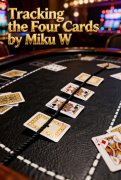
This is a trick for quickly locating four selections.
During an overhand shuffle, four cards are freely chosen, with no control involved. The spectators clearly see the cards lost in four different positions. Yet in the end, the magician can still locate all four selections with precision. For the full routine and effect, see the video demonstration.
- No force
- No gimmick
- No memory work
- No peeking
Performance transcript:
- This is a trick for finding four selections.
- Shuffle.
- Have the spectator call stop at any point.
- Remember the stop at card.
- Continue.
- Call stop again anywhere. ...
The Deaf Dealer
Paul Gordon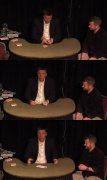
Four, say, duplicate Queen of Clubs magically change to four Ace of Spades. These then change to the four Aces. It's a beauty to perform and watch.
1st edition 2025, video 8:44
Darned Pain in the Neck
Paul Gordon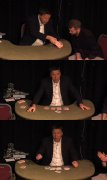
You try to show a Four-Ace trick, but the same indifferent card keeps appearing. The kicker ending is a shocker, and it's both funny and magical.
1st edition 2025, video 12:59
Slydini Psychology
D. Angelo Ferri
Dennis Barlotta, aka D. Angelo Ferri, studied with Slydini for 8 years. In this video, he is not teaching any tricks but explains the psychology and thinking behind Slydini's method of deception. How did Sldyini use his eyes? How did he involve spectators in a non-threatening way? Why did Slydini do the things he did? This video is intended to give magicians who are curious about Slydini a closer look at how he thought. Dennis will break it down and explain the thinking behind Slydini's system of misdirection and deception.
This video is a good introduction to the other instructional...
Double Serch
Miku W.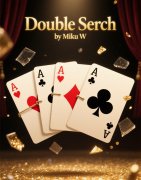
The magician begins by taking out four Aces. The spectator selects one red card and one black card, which are then returned to the deck and shuffled. The spectator is asked to cut the deck randomly into four packets. The four Aces are placed on top of each packet. The packets are reassembled. When the deck is spread, the four Aces not only gather together, but the red Aces sandwich the spectator’s red selection, and the black Aces sandwich the spectator’s black selection.
- No force
- No gimmick
- Impromptu performance
Performance transcript:
- Four Aces.
- Spectator picks a black...
Collenddon Aces
Paul Gordon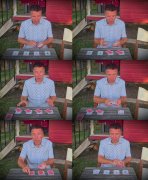
The effect is pretty standard, but the sneaky method isn't. Four Aces vanish, and one is located by spelling to it. What's more, the other three magically appear. Standard sleights.
1st edition 2025, video 13:38
Back and Forth Aces
Miku W.
A classic routine for producing the four Aces: the magician shuffles the deck and has the spectator cut the cards. The cards at the cut are shown to be indifferent, but with just a few throws of the two packets in the magician's hands, the four Aces are easily found.
1st edition 2025, video 1:57.
LWP Count
Peter Pellikaan
This count has one of the highest hide-to-show ratios of any false count. You are using four different cards, yet you can show each one three times in a row to credibly demonstrate you have a packet of three identical cards. Doing this four times with four different cards looks incredible on its own. Nevertheless, you would use this as part of a larger routine.
1st edition 2025, video 1:43.
Bandiquid
Doan
A rubber band is stretched across your open palm. You insert a pen under the rubber band and slowly start to stretch the rubber band further away from the palm. Everything looks fair and as it should be. Suddenly, the rubber band has melted through the pen without any apparent motion.
The rubber band and pen can be handed out for inspection. They are completely ungimmicked.
1st edition 2025, video 4 min.
Packet Palm
Peter Pellikaan
While you turn over a small packet of cards, you palm the bottom card. Here, Peter uses this move in a small packet routine to have Aces and tens change their packets.
1st edition 2025, video 3:59.
Mona Lisa
Brick Tilley
In the early '70's Jon Racherbaumer received 8 mm color footage of Chuck Smith executing a five-card poker hand switch. This was featured in the short film Lookout, Cleveland, now on YouTube. An excerpt is shown below. A letter from Smith is included here describing how he used it during WWII while in the military. This unique technique has been kept hidden until now. It is not easy, as many things are happening at once. This takes skill and nerve. The price is designed to keep it out of the hands of the curious. While we don't condone cheating, it is time this was recorded for posterity. ...
Compres No
Peter Pellikaan
A stunning color change. Four cards showing several pips, what Peter calls 'compressed cards', change into the four aces.
1st edition 2025, video 3:03.