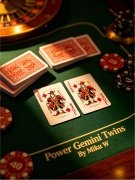
The spectator freely rolls four dice. The performer deals the corresponding number of cards for each roll, forming four piles. The performer then explains that the top faces give one set of numbers and the bottom faces give another, and has the spectator turn the dice over 180 degrees. The dealing continues according to these new numbers. When all the cards are dealt, the face cards of the four piles are all Kings. The performer asks why we look at both the top and bottom of the dice - because the four piles must also be read both ways. The bottom cards are turned over to reveal four Aces.
Performance transcript:
- First, shuffle the deck.
- Here are four dice for the spectator to examine.
- Make sure each roll comes up different.
- Then have the spectator give the dice a free roll.
- Because I'll deal a different number of cards based on each roll.
- So I want all the numbers to be non-repeating.
- These are the numbers the spectator rolled.
- We deal that many cards for each number.
- For example, if the first number is 6, I deal 6 cards.
- The second number is 5, so I deal 5 cards.
- This number is 2, so two cards.
- The number is 4, so I deal 4 cards.
- Those are the four top faces of the dice.
- But turned over, they give four different numbers.
- For example, the opposite of 6 is 1.
- All the bottom faces are different.
- So we deal again using the bottom numbers.
- For example, if it's 3, we deal 3 more cards.
- If it's 5, we deal 5 cards.
- 2 means two cards.
- 1 means one card.
- Everything is dealt strictly by the spectator's final numbers.
- We end up dealing to four Kings.
- But here's the question.
- Why do we look at both the top and bottom of the dice.
- Because the outcome also depends on top and bottom. Top gives four Kings, and bottom gives four Aces.
1st edition 2026, video 9:13.