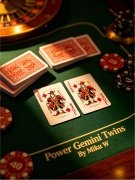
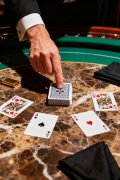
A completely self-working effect requiring no sleight of hand. The magician introduces a prediction card and has the spectator freely cut a small packet. The deck is then divided into three piles, and cards are dealt down according to a freely chosen number. The four Aces are cleanly located. In addition, the spectator's cut card, the prediction card, and the bottom cards of the three piles combine to form a Royal Flush. For the full procedure, please refer to the video demonstration.
Performance transcript:
- For this routine, I begin by taking out a prediction card.
- I place the prediction here.
- And here is a deck of cards.
- Next, I'll have the spectator cut off a small packet.
- But since I'll later divide the deck into several piles—their packet shouldn't be too large.
- Try not to exceed twelve cards.
- Have them cut off a small packet.
- Let's say they cut off this many.
- Now I'll divide the deck into three piles—twelve cards each.
- That's why we don't want more than twelve.
- I only need twelve at most.
- 1 2 3 4 5 6 7 8 9 10
- 11, 12.
- Twelve cards per pile.
- We don't need to move the rest aside.
- First, let the spectator count how many they cut.
- 1 2 3 4 5 6.
- So they cut six cards.
- Whatever they cut, that's how many I deal down.
- They cut six.
- So I move six cards to the bottom.
- Same here—
- I move six cards to the bottom.
- And again, six cards to the bottom.
- At the start I said this was a prediction card—my prediction is an Ace.
- The spectator freely cut a packet—and I adjusted the piles based on that number.
- In the end, these three piles—all have an Ace on top.
- But many people think—"Isn't this just another four-Ace routine?"
- Why call it a prediction?
- Because we still have the spectator's cut position.
- Let's look.
- The card the spectator cut to is a King.
- These three were randomly selected—and in fact the bottom cards of these piles were also random.
- If we turn everything face-up—you'll see I've successfully produced a straight flush.
1st edition 2025, video 6:56.