Derek Lever's Magic Mag, Volume 1
Published by Derek Lever, Peter C. Woolley & Taurus Magic, Manchester & Bury, Lancaster, England
Volume 1 consists of 6 issues, 260 pages total
Volume 1, Number 1, October/November 1979, 36 numbered pages plus 4 unnumbered cover pages
Candid Comments by The Editor - Derek Lever
Are Magic Societies Out of Date?
drawing collage of Chung Ling Soo
Blast from the Past - Chung Ling Soo - personality
This is a colleciton of the best of Daniel Tyler's inspirations over the past five years. The first section covers effects and routines, the second section moves. You will find new ideas and variations of old classics. Overall solid commercial material.
1st edition, 2005; 125 pages.
THE EFFECTS
Counterfeit Card The best method I have ever seen or come up with for a countdown routine.
P4 – Peppermint Patty Power Puncher A cross between Torn & Restored and Healed & Sealed ... with Peppermint Patties!
Dirty Laundry The cleanest and easiest card-to-sock routine.
Hugard's Magic Monthly consists of almost 2500 pages in 21 volumes and is packed with contributions from the finest artists and thinkers magic has to offer. People like Victor Farelli, Ted Annemann, Martin Gardner, Harry Lorayne, Milbourne Christopher, Ross Bertram, George Kaplan, Cliff Green, Fred Braue and Hugard himself. The subtitle says it all 'Devoted solely to the interests of magic and magicians'.
Jean Hugard and Fred Braue wrote some of the most read magic books in magic history, such as The Royal Road to Card Magic and Expert Card Technique. A good part of Martin Gardner'sEncyclopedia of ImpromptuMagic Tricks can be found in Hugard's Magic Monthly. It featured book reviews by John J. Crimmins Jr., and the famous Frank Joglar...
Some of the finest rope magic from Lewis Ganson, Peter Warlock, Van Rinkhuyzen, Anverdi, Faucett W. Ross, Jay Ose, Martin Gardner, Edward Victor, Stanley Norman, Norman Rashleigh, Harold G. Beaumont, C. F. Germelman, Horace E. Bennett, H. Fernandes, Bill Shewan and H. Fernandes.
Most likely you have never heard about this magic course. When I think about a 'magic gem' I have these 25 volumes in mind. This course could be called the 'British Tarbell Course' and in many respects it is much better than the Tarbell Course. It came out around the same time Tarbell issued his course and it had the same intent, to take a novice, introduce him to magic in a serious and thorough manner and give him all the information to develop him into a performer who can earn a living from performing magic. Rupert Howard's course does not cover as much ground as the Tarbell on trick technique, but quantity...
This is a pristine copy of the rare Rupert Howard Magic Course. It is an almost complete set of 23 lessons of the 25 lesson course. The two lessons missing are lesson 17 and 18. Each lesson is an oversized booklet with a color cover and glossy inside pages.
This course is rare and a perfect addition to any serious collector of magic books. Additionally you will receive a disc with the complete digital version of this set.
Most likely you have never heard about this magic course. When I think about a 'magic gem' I have these 25 volumes in mind. This course could be called the 'British Tarbell...
"I really like clever principles and if you're also a fan, you'll like this eBook a lot" – Michael Kociolek
More Mind Magic is a collection of four mentalism effects that are suited to close-up and especially one-to-one performance.
The first effect, Predetermination, is a completely self-working impromptu effect in which the mentalist correctly predicts the outcome of a card-mixing procedure, even though the spectator freely chooses the procedural steps after the prediction is made.
The second effect, Seven Shooter, is a packet trick with a Russian Roulette plot. The seven firing chambers...
Probably the greatest collection of close-up tricks ever assembled. And no card tricks are included in this first volume. It is so important not only because of its size (see the humongous table of contents below) and quality, but because the author has gone beyond the mere explanations of tricks and routines. The opening chapter, 'The Presentation of Close-Up Magic', embraces the whole approach to close-up performance. Includes hundreds of illustrations by Dennis Patten.
Michael Maxwell's Incredible Magic at the Bar is a six-volume series designed to teach you how to easily master and perform some of the greatest and easiest magic tricks. Each set in the series covers a different and unique type of magic, such as Bar Magic, Card Magic, Coin Magic, Rope Magic, Silk Magic, ImpromptuMagic, Mental Magic, Money Magic and many more.
Incredible Magic at the Bar, Volume 1 teaches you effects that are easy to perform on either side of the bar, but especially suitable for bartenders who wish to raise their image to a new level. Return customers are guaranteed; they will...
I have always believed that any close-up card rise, wherein the chosen card is "brought up" from the rear of the pack, loses so much of its effect because it must be ended too quickly, before the spectators see that the card did not really rise out of the middle. The effect of the trick is considerably strengthened by the appearance of the chosen card projecting from somewhere in the middle of the pack at the conclusion of the rise.
Jack McMillen's "PLUNGER" rising card trick was, to the best of my knowledge, the first method in which the chosen card rose from the middle...
Volume XV (June 1957 - May 1958), Jean Hugard, editor
123 pages
Note that Houdini's 'Unmasking' Fact vs. Fiction by Hugard ran as insert pages in each issue of Volume 15 and the first eight issues of Volume 16. Two pages from each of these issues do not appear here as they were extracted and compiled in a separate ebook.
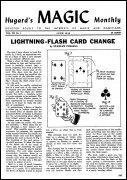
Hugard's Magic Monthly - Volume XV, Number 1 - June 1957 - 12 pages
Featuring mostly unpublished material and other rarities from some of America's Finest Creators. 49 contributors - 80 routines and moves.
JON ARMSTRONG
My Opening Act:
Deciding to show off your ESP skill and having only a deck of cards and a rubber band, you hand your deck out to be shuffled to a nice man named Ted. After he is finished shuffling, you ask Ted to place the rubber band around the cards to make them tamper-proof. You ask Ted if he will stop you on a card as you riffle them past his eyes. To prove to Ted that all is on the up and up, you offer to stare at his girlfriend Mary...