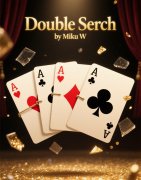
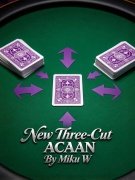
Two sandwich routines based on the same principle, each with a different handling and ending.
Completely self-working. No sleight of hand required. Performed with a regular deck. Fools magicians.
Miracle Count 15 & 47:
No complicated stack. The spectator freely cuts to a card and remembers it. The magician turns the 15th and 47th cards face up, then deals alternately into two tabled piles. The two face-up cards always remain in the same pile. In the end, they sandwich a single card—the spectator's selection. The other piles are then revealed to contain the four Kings.
15 & 47 Sandwich:
An earlier routine of mine. It uses a more complex stack, but the ending reveals the other three cards matching the value of the spectator's selection.
Performance transcript:
- First, shuffle the deck.
- This trick finds the spectator's card with no sleight of hand.
- So how does it work?
- First, remember two numbers: 15 and 47.
- These two numbers will help me find your card.
- Place the deck on the table.
- Have the spectator cut off a small packet.
- Then have them count how many cards they cut.
- 15 cards.
- While they count, I turn away.
- The spectator secretly remembers the number.
- Next, I'll deal through the cards one by one.
- The spectator remembers the card at their number.
- Since they cut 15 cards, they remember the 15th card.
- OK, remember that card.
- I said earlier that 15 and 47 would help me find the card.
- I need to locate the 15th and 47th cards in the deck.
- Here's the 15th card. I'll turn it face up.
- Now the 47th card.
- Here's the 47th.
- I turn both the 15th and 47th cards face up.
- Now I'll deal the cards alternately left and right.
- Just left and right, no changes.
- Both face-up cards end up in the right-hand pile.
- So we eliminate the left pile.
- And continue dealing the right-hand pile.
- Again, left and right.
- The face-up cards land together again in the right pile.
- So we eliminate the pile without the face-up cards.
- And continue dealing the right-hand pile left and right.
- As I keep dealing, fewer cards remain.
- Again they land in the same pile.
- One last time.
- The two face-up cards sandwich one card.
- And it's the spectator's card — the 2 of Diamonds.
- But I wasn't only finding the 2 of Diamonds.
- Why did I separate the cards into four piles?
- Because during the process, not only did I find the spectator's 2 of Diamonds, I also happened to locate the four Kings.
- This effect revolves around the numbers 15 and 47.
- These two numbers will help me locate the spectator's card.
- Have the spectator cut off a small packet and count the cards one at a time.
- There are exactly 15 cards here.
- Next, I'll deal through the cards one by one and the spectator will remember the card at the number matching the size of their cut.
- For example, if they cut 10 cards, they remember the 10th card.
- Since they cut 15 cards, the spectator secretly notes the 15th card.
- Remember this card.
- In performance, the spectator freely cuts a packet and freely thinks of a card.
- The spectator's cards are mixed together with mine.
- At this point, I have no idea which card the spectator remembers.
- But that doesn't matter.
- Because the numbers 15 and 47 will guide me directly to the selection.
- First, I count to the 15th card.
- The 15th card is turned face up.
- Then 47 — the 47th card.
- Both the 15th and 47th cards are reversed face up.
- Now I'll separate the deck into two piles, one to the left and one to the right.
- You'll notice the face-up cards always end up in the pile on the right.
- So I eliminate the left pile and keep the right-hand pile.
- Then continue dealing and eliminating packets.
- Continue dealing the cards.
- The fourth pile.
- At the end, two cards remain with one card trapped between them
- Ask the spectator to name their card.
- The selection is successfully revealed as the King of Hearts.
- But the procedure feels rather long.
- All this just to locate one card — why deal through the entire deck?
- Because during the process, I also located the other three Kings for the spectator.
1st edition 2026, video 20:06.