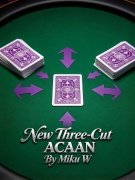
A creative take on a classic principle.
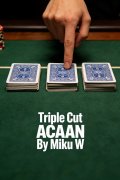
The spectator freely selects a card, returns it to the deck, and shuffles. The magician then has the spectator cut the deck three times, changing the order of the cards with each cut. None of the three cut-to cards is the selection, but their values add up to the exact position of the selection in the deck.
1st edition 2026, video 6:05.
Performance transcript:
- First, shuffle the deck.
- Have the spectator freely select a card.
- Remember the selection.
- Insert the selection into the middle of the deck.
- Give the deck a cut.
- Next, I'll give the spectator three chances to cut to their selection.
- Place the deck on the table.
- First, have the spectator cut off a small packet.
- Turn the cut-off packet face up and replace it on top of the deck.
- The face-down-to-face-down junction now marks the position where the spectator cut.
- Now we'll make three cuts.
- Have the spectator cut off a larger packet.
- Turn this packet over.
- Locate the face-down-to-face-down junction.
- This is the first card.
- Have the spectator cut off another packet and place it on top.
- Then locate the face-down-to-face-down junction.
- Repeat the procedure.
- This is the third cut.
- Locate the face-down-to-face-down junction.
- These three cards were freely cut to by the spectator.
- 2 of Hearts, 4 of Clubs, and 3 of Spades.
- Is your selection among these three cards?
- The spectator says no.
- There's another advantage to cutting the cards this way.
- Each cut also changes the order of the deck.
- You've freely cut to three cards.
- None of them is your selection,
- but they might reveal its position.
- 2+4=6 6+3=9
- Your selection is at position 9.
- Count down to the ninth card.
- The King of Diamonds.
- That's your selection.