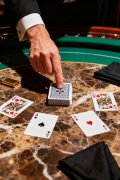
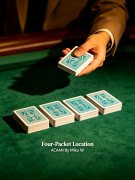
The magician begins by taking out 9 cards. A spectator then freely cuts off a packet, counts the cards, and remembers the card at that corresponding number. After that, the spectator freely selects 3 cards from the 9, and the sum of those values not only locates the original selection but also reveals the other three cards of the same value.
A classic principle reworked with a special setup turns this into a much stronger ACAAN-style routine.
Full effect shown in the performance video.
Performance transcript:
- Here I have nine prediction cards.
- I won't need them yet, so I'll set them aside.
- And here are a little over forty cards.
- Have the spectator cut off a small packet.
- But not more than twenty cards.
- Let's say they cut this many.
- I'll turn around and let the spectator deal them one by one, to count how many they cut.
- Since I don't have a spectator, I'll count myself.
- 1 2 3 4 5 6 7 8 9 10 11 12 13 14
- So they cut fourteen cards.
- In performance, turn back around.
- Since I don't know their number, I'll just roughly count twenty cards.
- We don't need the rest—give them a quick shuffle and set them aside.
- Now I'll deal the cards one by one and have the spectator secretly remember the card whose position matches the number they cut.
- So if they cut fourteen, they remember the 14th card.
- 1 2 3 4 5 6 7 8 9 10 11 12 13 14 15 16 17 18 19 20 good.
- In a real performance, the spectator secretly remembers the 14th card.
- I don't know which number they used.
- I don't know how many they cut.
- It's completely random.
- Where is their card now?
- I have no idea.
- Doesn't matter.
- I said we have nine prediction cards.
- We don't need all nine of them.
- The spectator can help choose the prediction.
- This prediction effect doesn't rely only on my choice—the spectator can choose the prediction cards.
- I'll deal the nine cards into a 3×3 grid.
- Ask the spectator to freely choose one.
- Let's say they first choose this one—it's an 8.
- Remove all adjacent cards.
- That means the cards above, below, left, and right.
- Then let them choose another card.
- Suppose this time they pick a 9.
- Same thing—remove its adjacent cards.
- The last remaining card is a 4.
- So the spectator freely selected 4, 8, and 9.
- They could've chosen anything—but we end up with three cards.
- These three freely selected cards represent three numbers.
- Whatever the numbers are that's how many we deal.
- First number is 8—so we deal 8 cards.
- 1 2 3 4 5 6 7 8
- Second number is 9—completely chosen by the spectator.
- 1 2 3 4 5 6 7 8 9
- So I deal 9 cards.
- Third number is 4—1 2 3 4
- Once all numbers are dealt, I ask what their card was.
- They say: the Queen of Clubs.
- And this card happens to be the Queen of Clubs.
- But there's something else.
- We only needed to find one card.
- So why use three prediction cards?
- Isn't three cards overkill for one selection?
- Actually, no.
- These three cards not only locate the Queen of Clubs—they also reveal the other three Queens.
1st edition 2025, video 8:10