Gaffed in Cards







Products
Backs no Aces
Peter Pellikaan
Four cards with the same backs change their design every time they are turned over. Eventually, they change into four aces with different backs.
1st edition 2026, video 2:29
The 5s
Peter Pellikaan
Four 5s change color multiple times. First, they magically turn around one by one. Then they become double-faced cards. And then their faces and their backs change into completely new designs.
1st edition 2026, video 4:01.
Sniff Crosses
Peter Pellikaan
A bewildering number of color changes. You first show four five-of-diamonds. They suddenly have large crosses drawn on their faces. The crosses also appear on the backs. Then they change to the four aces, and on top of that, each ace has a different back design.
1st edition 2026, video 2:59.
Sniff 8
Peter Pellikaan
You start with four blue double-backers. They turn into four red double-backers. And then they change into four of a kind, for example, the four eights, and each one has a different back.
1st edition 2026, video 1:53.
Colour Back Aces
Peter Pellikaan
You show four cards with yellow backs. On the other side they all have green backs, meaning they are double-backer cards. Then where there were yellow backs, there are now blue backs. Then the cards turn into the four aces. Then the backs change to red backs. Eventually, each ace has a different coloured back.
1st edition 2026, video 2:14.
Sticky Situations
B. Robert Pulver
This book contains a collection of effects utilizing one of my favorite gimmicks: double-sided tape.
This hard-to-find ebook is once again available for purchase. Contains 12 illusions, plus a tutorial on printing custom cards.
"... strong magic... interesting plots... devious methods. What more could one ask for?" - Martin Lewis
"... will keep you glued to the pages." - Paul Hallas
YFW!
Four Jokers and an Ace are shown. The Ace is set aside. One by one the four Jokers turn face down. But wait... this trick doesn't use four Jokers and one Ace. It uses...
Tarot Ex Machina
Bob Farmer
"Absolutely Amazing." - Roberto Giobbi
"Incredible thinking." - Teller
The most wonderful gaffed Tarot cards (or even playing cards) ever conceived. A gaffed deck of the 22 Major Arcana cards infused with multiple layers of deceptive mechanisms.
METHODS NEVER BEFORE POSSIBLE: with the Major Arcana for predictions, mindreading, magic squares, Out of This World, vanishes, teleportations, and more.
SPECTATOR CUTS TO A CARD. You immediately know the card and its position in the deck.
A SPECTATOR CUTS THE DECK INTO THREE PILES. You immediately know the bottom card of each...
Secret Decks
Pablo Amirá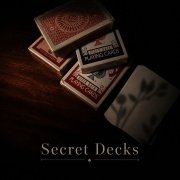
A compilation of four of my gimmicked decks that I use constantly in both professional and casual performances.
Serendipity Deck: (From the No Briefcase Act) Any named card is predicted using the two Jokers from the deck. A dynamic and entertaining approach to predicting any freely named card.
Smile Deck: (From the Motivational Mentalism Act) The named card is the only one with a smiley face in an otherwise blank-backed deck. No roughing spray, no thin cards.
Telepathic Deck: Your participant merely thinks of any card, and you instantly know it. A forgotten classic reimagined through...
I Hate Card Tricks 3
B. Robert Pulver
A collection of miniature stage illusions using playing cards.
Still more miniature stage illusions from the critically acclaimed "I Hate Card Tricks" series. Volume 3 features effects based on both classic and contemporary stage illusions.
This hard-to-find e-book is once again available for purchase. Contains instructions for constructing and performing 12 illusions, plus a tutorial on printing custom cards.
The Aztec Queen
This effect is based on the "Aztec Lady" illusion. A Queen is placed into a playing card cabinet. She can be clearly seen through windows in the front of...
I Hate Card Tricks 2
B. Robert Pulver
A collection of miniature stage illusions using playing cards.
What's that you say? You still hate card tricks?! Here, in volume two, I present an all-new collection of miniature "stage illusion" recreations made popular in the original I Hate Card Tricks.
This hard-to-find ebook is once again available for purchase. It contains instructions for constructing and performing 11 illusions, plus a tutorial on printing custom cards. Foreword by Martin Lewis.
The Origami Queen
This effect was inspired by Jim Steinmeyer's "Origami" illusion. A signed Queen is placed...
I Hate Card Tricks 1
B. Robert Pulver
A collection of miniature stage illusions using playing cards.
This hard-to-find ebook is once again available for purchase. It contains instructions for constructing and performing 11 illusions, plus a tutorial on printing custom cards. Foreword by Marty "Martini" Grams.
"Highly recommended ... pure genius ... 10 out of 10." - Marty "Martini" Grams
"...the effects look so astonishing." - Aldo Colombini
"Remarkably different and visual." - Kenton Knepper
The Divided Queen
This effect was inspired by Jim Steinmeyer's illusion, "Modern Art." Your assistant...
The Shadow Card: the duplicate card
Dustin Marks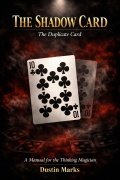
Are you tired of magic effects that fool people - but don't amaze them? Have you ever watched a spectator's face "break open in genuine, unguarded astonishment" and realized they weren't amazed by a trick, but by a fundamental violation of reality?
Most magicians treat the duplicate card like a last resort. A gimmick. Something you use when you don't have the chops for the "real" method. That's exactly backwards. The duplicate card doesn't ask your spectator to miss something happening in front of them - it asks them to fail to conceive of something entirely. Nobody watching card magic...
The One-Way Forcing Deck
Dustin Marks
Here's a question worth sitting with for a moment. What if you already knew the card before the spectator touched the deck? Not because you're skillful. Not because you're fast. Not because you forced it with your hands. But because no matter what they do - shuffle, cut, mix, choose freely - they are going to pick the same card every single time.
That's the one-way forcing deck. And in the right hands, it's the most devastatingly fair-looking card magic you can perform.
What this eBook covers: The one-way forcing deck is one of the most underrated tools in card magic. Most performers...
Predictive Switch
Mark Leveridge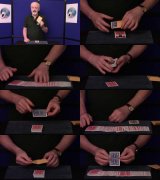
The performer offers to demonstrate an effect that is part mentalism and part magic. For the mentalism part, he slides a blue-backed prediction card from a pay envelope, displaying that the envelope is otherwise empty before returning the card and leaving the envelope in view.
A red-backed deck is shown to be well mixed, and a spectator genuinely freely (no force) touches the back of any face-down card. This selection is left reversed in the centre of the deck.
The blue-backed prediction card is now removed from the envelope and its face displayed - let's say it is the QC. When the red...
Miracles in Pairs
Sam Dalal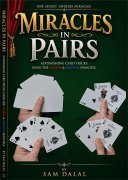
Astonishing card tricks using the rough and smooth principle.
The R&S (Rough and Smooth) principle is one of the best subterfuges of card magic, with trick decks like the Brainwave Deck by Dai Vernon (originally described in October 1938 - Issue 49 of Annemann's Jinx) being one of the classic trick decks of all times, and several dozens of other decks and packet tricks based on this principle.
Basically, cards roughed with roughing treatment cling together in pairs, to show as a single card when fanned with slight pressure, and separate when fanned lightly.
One can...
Black Art 2
Peter Pellikaan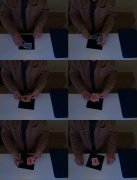
You start out with four cards with a blue back on both sides. They transform into four cards with red back designs on both sides, plus they have a big hole through the middle.
1st edition 2026, video 1:49.
Royal Jokers
Peter Pellikaan
You show five Jokers, arrange them into a face-up and face-down pattern, and suddenly they are a royal flush.
1st edition 2026, video 3:17.
Jokers and Kings
Peter Pellikaan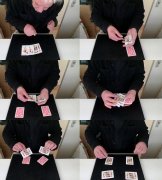
Two jokers and two kings change places multiple times. You end with just four kings.
1st edition 2026, video 2:35.
Little Cards
Brick Tilley
We feel this is the Holy Grail of gimmicked card effects. At a 1971 lecture in New Orleans, Bro. John Hamman exhibited this masterpiece to a small group of stunned magicians. To construct and perform it requires a glue stick, a pair of scissors, minimum DIY skills, and half a brain. The video demonstration below speaks for itself.
1st edition 2026, video 2:35
Pick a Joker
Peter Pellikaan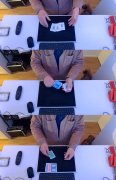
You show four jokers and they all have the same back. The spectator picks a joker, and it has a different back to what was shown before. You will receive three variations of the same theme.
1st edition 2026, video 7:57.
No Black Art
Peter Pellikaan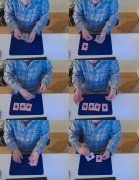
You start out showing four blue cards. One by one, they turn red, and they have a big hole cut in the middle. This hole is not a fake. You can put your finger through it.
1st edition 2026, video 2:07
Red Dots
Peter Pellikaan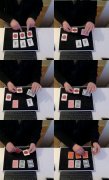
Six cards, three have a large red dot on their face, and the other three are jokers. The red dot cards change their backs multiple times.
1st edition 2026, video 2:35
Combination
Peter Pellikaan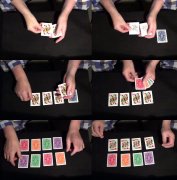
8 cards and a bewildering number of changing faces and backs. Watch the demo video below.
1st edition 2026, video 5:32
Faux Card To Pocket
Brick Tilley
A quick, convincing, smart version of this classic. No heavy lifting here. The vanish is clean, the action deliberate, few if any angle concerns, little skill required. Can you afford not to invest the minimal effort required to include this startling vanish/production among your surprises? You have nothing to lose and everything to gain.
1st edition 2026, video 38s.
Twisting Hole
Peter Pellikaan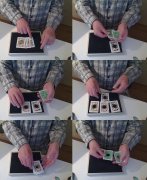
Four cards are shown and counted repeatedly. Every time through the count, one card suddenly has a big hole through its center. These are real holes you can put your finger through. This goes on until all four cards have holes.
1st edition 2026, video 2:13.
Total Hallucination
Dustin Marks
This is not just a card trick. It's an experiment in the fallibility of human memory and perception. With one card you create a miracle!
A single card is placed on the table by the spectator. Both spectators look at the card, and yet they see different cards. The magician never touches this single card. In the spectator's mind this is a hands-off miracle.
This effect creates a moment where the spectators question their own perception and memory!
Two variations: One variation is simple with no preparation; the other version requires a two-way forcing deck, but this leads to an impossible...
The Gift 3
Unnamed Magician
In this PDF, I am publishing a very strong variant of my effect The Gift. I call this variant The Gift 3 - I've already published another effect called The Gift 2, hence this is the third effect in the series.
If you first watch the performance video of The Gift (using the aforementioned link) and then you watch the performance video of The Gift 3 (below), you will notice a crucial difference that makes this variant more impossible-looking. Thus, this variant is a good performance piece for those magicians who are aware of the workings behind the original The Gift...
The 4 Tens
Dustin Marks
Effect: Four spectators shuffle the deck, and each of them freely selects a card. The selected cards are the four different tens: 10 of Clubs, 10 of Hearts, 10 of Spades, and 10 of Diamonds. The magician seemingly never touches the cards.
Description: I wanted to create an effect where four spectators shuffle the cards and have a free choice of any card. Each spectator's card is of the same value. Ex: the 4 Tens: Hearts, Diamonds, Clubs, and Spades. In the spectator's mind, all the cards are different by using a very deceiving ruse.
My other requirements are that the magician never...
5 Spad
Peter Pellikaan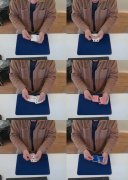
A small packet trick with several color changes. First, you have four blank cards. Then slowly, one by one, they turn all into the 5 of Spades. Then they all get red backs, and finally they all get blue backs.
1st edition 2025, video 2:46
Easy and Nice
Peter Pellikaan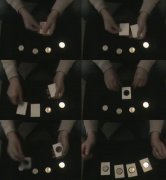
Four blank cards, shown from both sides, suddenly have big holes cut through their centers.
1st edition 2025, video 4:25.
Forbidden Fruit
Stephen Tucker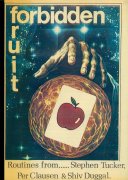
Five lovely small packet routines involving apples from Stephen Tucker, Per Clausen, and Shiv Duggal.
The last routine plays off the 'Apple' computer angle. With Apple Inc. having made such a meteoric rise, with many having Apple computers or phones, this routine would probably play even better today than it did during the 1980s. Some changes in the patter will be necessary, but the general idea has merit.
The booklet came originally with six custom cards showing apples and an apple core, some with blank backs, some with regular backs. These cards are not included with this download, but...
The Impossible Card Discovery
Dustin Marks
In the art of magic, the ultimate goal is to create a moment of pure, unadulterated astonishment - an experience so clean and impossible that it transcends mere trickery and feels like real magic. For the spectator, this requires an effect built on a foundation of total fairness. The challenge is to guide them to a place where the only remaining explanation is: your spectator has just experienced the impossible.
Effect: Imagine this from your spectator's perspective. You are handed a deck of cards. You inspect it and shuffle the deck. When you are satisfied, the magician turns his back....
A Stunning Transposition
Dustin Marks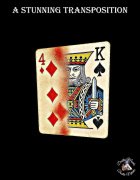
Effect: The spectator shuffles the deck and cuts it, looking at the card he cut to (4D). The magician does the same showing his card to the spectator (KS). He places that card (KS) face down on the table. The magician spreads the deck face up, revealing one face-down card. It is the magician's card. The card on the table is the spectator's card.
Description:
Are you looking for an easy-to-do card effect that delivers an astonishing transposition while convincing the spectator they are in full control? This is the card transposition the spectator does not see coming.
Maximum deception...
Miracles with Double Facers
Dustin Marks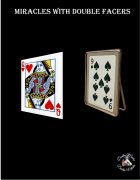
We have all heard of double-facers. They seem odd and dangerous. This eBook provides an in-depth analysis of double-facers (DF) and how they can enhance the success and deception of your routines.
This eBook is a comprehensive guide explaining DF principles, how to safely handle DFs, strategies, and 7 specific magical effects. This is the secret weapon that hides in plain sight. Double-facers are not known to the public. Discover how double-facers combine with double-backers to create miracles.
7 Effects:
- A Monte Effect
- A Mysterious Open Prediction
- A Great Indicator Card
- A Wild...
Bammo Hand O' Doom
Bob Farmer
The Spectator thinks of a card. Only he knows its identity. Cards are mixed together face-up and face-down. Now - in rapid succession - there are three shocking climaxes:
- Instantly, all of the cards turn face-up - with the exception of the thought card. It is the only card still face-down!
- Suddenly, the thought card vanishes and turns into the Hand O' Doom.
- The Spectator reaches into his pocket and finds among some other cards he placed there previously - the missing thought card.
FEATURES
- Entirely mechanical and self-working: requires no skill, no memorization, no sleights. ...
Miracles with Double Backers
Dustin Marks
We have all heard of double backers. They seem odd and not very useful. This eBook offers a comprehensive perspective on the power of double backers (DB), and how they can elevate the impact and deception of your routines.
- This secret weapon hides in plain sight
- Double backers are generally not known by the public
- Simplify complex effects using a double backer
- Double lifts are more deceptive and look more natural
- Hands off Forces – The magician never touches the deck! And you can force more than one card
- Seamless Transitions: Utilize the DB to create the illusion that a spectator's...
The Perfect Force
Unnamed Magician
"Fantastic force, the combination of methods is very fooling." - Kevin Aust
"The best card force I have ever seen." - Alexander Javier
"Beyond perfect, not just perfect." - Tony Bianco
There are many card forces out there. Too many, actually. But, in my opinion, none of them are 'perfect' from an effect standpoint. Some come close - however, I have yet to see one that fully gets there.
From an effect standpoint, what ingredients must a force have in order for it to be considered 'perfect'? I think these 6 ingredients are the answer:
- The magician must never touch the cards...
Nononono Hole
Peter Pellikaan
You show four cards. When you separate three of them, they suddenly have big holes cut out in their center. The fourth card has no hole.
An alternative routine using the same gimmick is shown below. This routine is not taught in the download. However, once you have learned the first routine and understand the gimmick, you should be able to understand how the routine below works. You show one regular card and three cards with a hole in the center. The three cards with a hole are blank. But once you combine them with the regular card, the holes vanish, and the faces are not blank anymore. ...
Compres No
Peter Pellikaan
A stunning color change. Four cards showing several pips, what Peter calls 'compressed cards', change into the four aces.
1st edition 2025, video 3:03.
Impossible Coincidence
Dustin Marks
Effect: Two decks are examined and shuffled by spectators. A card is freely chosen from a third deck The Queen of Hearts (QH) and turned face up. The (QH), mysteriously appears at the same position in the two independently shuffled decks. The magician seemingly never touched the cards.
Imagine: Two spectators each shuffle a deck. From a third deck, a card - the Queen of Hearts (QH) - is freely chosen and turned face up. With seemingly no involvement from the magician, both spectators are instructed to count down to the same specific number of cards in their shuffled decks. The unbelievable...
The Prophetic Revelation
Dustin Marks
Effect: A written prediction that the spectator has their finger on changes places with the card the spectator saw in the deck. A vanish, transposition, and a prediction all in less than 60 seconds.
Imagine this: Your spectator places their finger on a card they believe contains a written prediction. They then select a card from the deck. When the dust settles, the card they selected has vanished from the deck, and the very card under their finger, the one they thought was the prediction, is revealed to be their selected card. Meanwhile, the prediction card appears in the deck, proving...
Morning Twist
Peter Pellikaan
This is a "Twisting the Aces" routine, here performed with the Jacks, that includes two color changes of the backs. First, they change from blue to red, and then the Jacks all have different backs.
1st edition 2025, video 3:32.
Two Card Persuasion
Dustin Marks
The magician repeatedly influences the spectator to correctly guess the color (red or black) of a hidden playing card.
Imagine carrying just two cards and engaging your spectator in an effect based on persuasion and influence. With just two cards, you can make the spectator believe you have the power to influence his decisions at will.
The effect provides an understanding of persuasion for the spectator and, at the same time, aims to create rapport with them. Once rapport is established, the spectator may be interested in seeing your additional effects.
If you are looking for something...
Nice
Peter Pellikaan
Four cards with backs on both sides turn into four queens, then back to backs, and then again to four queens.
1st edition 2025, video 2:09.
Open Prediction: the best approach
Unnamed Magician
This is the third (and probably last) open prediction effect that I'm publishing. The other two that I've already published are called Open Prediction: A New Approach to a Classic Plot and Open Prediction: The Simplest Approach. I call this one Open Prediction: The Best Approach because, of the three, it is the strongest one (at least in my opinion).
Imagine:
The magician introduces a deck of cards - he spreads it to show that all the cards are different, and then hands it to the spectator. At this point, the magician openly predicts a card by naming it out loud.
The spectator is invited to cut off any number of cards and to flip them face-up on top of the rest of...