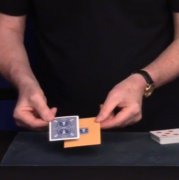
The effect was created by Peter Duffie. An effect which must give the impression that you are a fantastic card expert. Two cards are placed face up on the table. You now show four misprinted cards that have backs on both sides - except for one, which has a back and a blank face. You now add the first card to the packet and suddenly all the cards print with faces of the selection! You repeat this with the second card to cause all the cards to print to duplicates of this card! Finally you pick up the card with the blank face. "This," you state, "is an eraser!" You now prove this to be so because, suddenly,...
First up is Jacks in the Box. On the table sits a single card box. It is explained that the box contains the four jacks, and only the four jacks. However, there is one jack that is face up. A spectator is asked to name any suit. Suppose he says, "Spades". The box is opened and the four cards are removed. They are face down with red backs. The cards are then shown one at a time and the Jack of Spades is face up among the three red backed cards. The Jack of Spades is then turned face down to reveal that it has a blue back. Finally, the red backed cards are shown to be blank on the...
... knowledge was transmitted in this primitive, semi-private, and intimate means. Word-of-mouth reigned supreme and to a certain extent still does.
The magic scene in the Seventies was a blooming, buzzing place, atwitter with contentiousness and creativity. Close-up magic, particularly with cards, was becoming better. Tricks were becoming more interesting, finessed, and sophisticated. Many magicians became knowledgeable and expert: Fast-Company Men, too hip for each other, too hip for most rooms, and too hip for their own good. Magic for magicians took hold and had to be magician-proof....
The spectator cuts the deck as much as he wants. The magician picks up the deck and deals the cards singly from the top. When the spectator stops him, the magician tables the deck and turns away. The spectator remembers the value of one card and the suit of another card where he stopped at. He gathers the cards - he can even cut the deck - before the magician faces him again. Then, the magician asks the spectator to concentrate and makes two assertions, one about the color and one about the value. The spectator tells him if he is right or wrong both times. Whatever the outcome is, the magician...
This is the fifth in a series of download DVDs dedicated to tricks and routines using ESP cards. This volume 5 features routines by a range of famous authors.
Contents:
SYMBOLICLUE (Werner Miller): A spectator picks a card. The other cards are dealt in four packets and assembled randomly. When you turn over the cards in pairs only four cards match (say four Squares), the fifth symbol is the selected one (Square).
WHITEWASH (Peter Duffie & Robin Robertson): Four cards with numbers shuffled by a spectator are used to find four symbols (say all Square), that match your prediction. At the end all the other cards are blank. This...
Created by Cameron Francis. Performed by Aldo Colombini. You introduce a packet of four cardsblank on both sides. You split the cards into two piles of two cards each. Two cards are selected from a deck. You push the top card of one pile and on the lower card a message is revealed which reads, SPREAD THE DECK. The deck is spread and in the middle a face-up selection appears. The top card of the second pile is pushed forward and there's a message on the second card that says, TURN OVER THE TOP CARD. The top card of the deck is NOT the selection, but in turning over the top card of the pile a...
Three of Mark's previously published lecture books in one convenient download:
The Mark Leveridge Lecture Experience
Solutions
The Serial Thriller Lecture Book
The Mark Leveridge Lecture Experience
In this 82 page ebook there are some tremendous practical close up and mental items using cards, coins, rings, matches, envelopes and bank notes, with virtually no specialist equipment required. By using a subtle blend of good routining and some sleight of hand, many interesting and novel effects are created for you to use.
Some of Mark's best work is here - items such as 'It Pays To...
as "methods," consisting of sleights, principles, and subtleties. In addition to these means to an end are 80 complete tricks. These include 30 card tricks, eight of which are suitable for platform presentation as well as close-up work; 29 mindreading effects, of which 19 make use of playing-cards and ten employ "props" of other kinds; six tricks with coins; and 15 miscellaneous effects, six of which are classified by the author as platform feats. In the final chapter, entitled Concluding Observations, Mr. Kaplan gives some sound advice on the selection, routining, and indexing of tricks, and lists the items which make up three of his own programs, selected from among the feats explained in his book.
PLAY IT AGAIN SAM (Peter Duffie & Roy Walton): Seven pairs are shown and then separated. They assemble again in pairs with a final surprise.
TRANSPO INK (Fabian-Aldo Colombini): Four cards with red spots and four cards with blue spots. They change place one by one (can be done with regular cards as well).
FOUR GONE CONCLUSION (Bob Haines): Two selected cards are lost in the deck. Four cards are shown to be all alike. Two of the cards disappear and the two left are the selections.
YOUR VERY OWN (Roy Walton): A group of cards is mixed by a spectator and then magically sort themselves out into...
Between the covers of this book, you will find effects which are both quick and fun to perform, as well as items which play longer and are more involved. I think that you will especially enjoy the effects using ropes because Aldo introduces some clever new twists, which, if put together with your own Cut and Restored or Professor's Nightmare routines, will make a winning combination!
Table of Contents
Introduction
Turn Over Revelation: Two selected cards are revealed in a spectacular way!
A small envelope with a hole cut from its address side is examined. A deck of blank-faced cards is then freely displayed and one blank card is openly slid into the envelope which is left in view.
From a regular deck, a spectator touches the back of any card. Let's say it is the 6C. This card is waved over the envelope and when the previously blank card is slid out it is seen to have now printed itself to match the selected 6C.
Without a doubt, this "matrix" with playing cards created by Aldo is truly special. A splendid opening routine and a surprising ending.
The classic trick of four coins that gather under a card is presented here with playing cards that are found under a jumbo card. The manipulations are really simple; they should already belong to the repertoire of every magician. In a close-up magic program, this could be the only card trick to be presented.
Effect: The A, 2, 3 and 4 of Diamonds are placed on the table, in a square formation. The cards are covered...
... for the money. In the Marlborough Arms, a pub around the corner of the old Magic Circle at Chenies Mews and the unofficial "office" of Pabular, Eric Mason would regularly weave his magic every Monday night.
Maybe memory plays its own tricks but watching Eric Mason perform his vanishing pack of cards under a wallet, a glass penetrating the closed fingers of a spectator's hands (Moniker - Volume 3, Number 2, Page 313) or his colour changing packet tricks that seemed to go on and on until the spectator just could not believe that any more changes could take place (The Problem Is… - Volume...
 ...