Billets in Mentalism & Spiritism: page 1
Products
With the Eyes of Dr. Reese
Robert A. Nelson
Here is a miraculous, "test conditions" billet reading method that is both fiendishly clever and imminently practical. Leave it to the fertile brain of Bob Nelson to develop a billet test as good as this!
The sitter writes any question on a slip of paper and folds it tightly. She drops this into a glass tumbler. Sitter then takes her own handkerchief and places same over mouth of glass. A rubber band is used to snap around the edge of glass, holding the handkerchief in place.
The glass, containing the spectator's billet, is left standing on a table throughout the test. The performer picks...
Center Tear Methods
Ulysses Frederick Grant
The center tear is, without question, the finest all-around method for gaining information written by a spectator. The main advantage of the center tear is that it is always ready to use, a small slip of paper is all that is needed.
In the past, many performers went to U. F. Grant seeking a way to use the center tear effectively. The problem which confronted most of them was how to read the written message without being detected. This problem confronts nearly everyone who wants to use the center tear. And it has been the reason many performers have avoided it.
In this eBook are revealed...
How to Read Sealed Messages
Robert A. Nelson
The most comprehensive and authoritative book on sealed billet reading, as employed by mentalists, magicians, and office mediums.
Divided into three sections, this ebook deals with methods used by office mediums (section 1), stage mentalists and psychic entertainers (section 2), and a bonus section on how to maximize revenue from shows with a secret tip for selling 'back of house' books and merchandise (section 3).
SIXTEEN methods are described and explained in detail as used for private office work. Many of these are adaptable to mentalist and magic uses, and can be presented without...
S.P.I.T: Secretly Peeked Information Technique
Scott Creasey
For the first time in this 15 min video (yep 15 mins it's that easy) Scott reveals the business card peek he has been using in his close up mentalism performances for many years. No manufacturing or craft skills required, no peek wallets, no business card cases, no envelopes, no special pens or any other paraphernalia, just your business cards and a pen.
One totally impromptu method, one requiring a one off 30 second set up and three variations to suit all styles.
Drop half a dozen of your business cards in your pocket along with a pen and you are all set to perform drawing duplications,...
Underground Bottom Tear (UBT)
Dustin Dean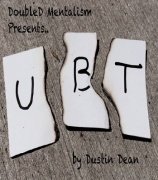
One of the easiest and most natural tears you will ever learn.
For more than two years I've been using this practical tear to perform powerful and direct mentalism. For a long time I've kept this completely to myself, but it's come time to share this with all of you.
Imagine a tear where in just two simple tears you get your peek and the dirty work is done. Imagine a tear where you can show all sides of the paper as you tear, meaning no heat is on you because the participant sees exactly what you see. Yet you are easily able to peek 50% of the entire paper. Imagine a tear that is incredibly...
Mentalism Masterclass 4: billets
Peter Turner
Table of Contents
- Introduction
- The Psychology of Peeking
- Peek a Boo
- Envelope Peek
- The Pac-man Peek
- The Lotus Leaf Peek
- Prayer Peek - Pablo Amira
- Casual Peek - Pablo Amira
- The Block Peek - Dee Christopher
- The Fall Peek
- The Clip Peek
- To Justify or not Justify? - That is the Question!
- Seven Keys to the Baldpate (modernized)
- Alternatives to Blank Card Stock
1st edition 2016, 75 pages.
The Complete Guide to Billet Switching
Tony Corinda & Ralph W. Read
This is a combination of Corinda's Step 6 of his 13-Steps to Mentalism on Billets, and Ralph Read's One Man Mind Reading Secrets.
Part One Technique
- Introduction
- A Few Simple Rules For Working with Billets
- The Centre Tear - Corinda Variation
- The Centre Tear - Punx - Meir Variation
- Centre Tear - One Hand Variation
- Centre Tear - Corinda's Backward Variation
- Centre Tear - Preparation of the Billet
- Centre Tear - Reading the Billet
- Billet Switch - Bare Hand Method
- - Billet Switch (Annemann)
- - The Billet Switch Bare Hand Method (Corinda)
- Billet Switch by Lapping
- Billet Switch - Magnetic Clip...
The Knight Billet Revisited
Ronald Levy & Devin Knight
The Knight Billet Revisited is a comprehensive sequel to The Knight Billet, but this eBook is designed as a standalone PDF. You do not need the original eBook to understand or appreciate the material in this release. This is a new variation on the original Knight Billet that makes doing Annemann's billet routines even easier than the original Knight Billet. Yes, you can secretly open this variation on the Knight Billet even faster.
In this ebook, you get step-by-step photos showing you how to fold the billet and step-by-step photos on how to secretly unfold it in a few seconds, with no fumbling, as with the standard Annemann billet. You will...
The Knight Billet
Ronald Levy & Devin Knight
A break through in billets that you need to know if you do billet effects.
Richard Osterlind is correct when he says that many mentalists stay away from Annemann's billet work because it seems hard to do. For most magicians and mentalists, it is difficult to do. They struggle with opening the Annemann billet in their pockets; they fumble and quickly give up. The basic idea is to switch a billet for a blank one and secretly open it in your pocket or behind a clipboard or book. This can be difficult with one hand, especially if you are using an Annemann billet.
That has all changed thanks to Ron Levy,...
The Dr's Billet Tear
Dr. Bill Cushman
"I use my own Perfected Center Tear all the time. But I have to tell you this; I use a piece of paper from my pad. When I saw how clean Bill's version looked with a business card, I had to learn it too. It is smart to have a variety of methods at your disposal. Dr. Bill's Billet Tear is top notch and as good as it gets. If it means anything from a guy who has been ripping paper up for most of his life, take my advice and get this!" - Richard Osterlind
What should you look for in a Center Tear? As little as possible! On that note:
"Here's a word I think describes the pinnacle of...
Centermental
J. G. Thompson Jr.
The origin of the center tear is unclear. Some say it was used by mediums for a long time before magicians found out about it. Theodore Annemann was the one who made it popular among mentalists. Others believe that Martin Sunshine invented it, who passed it on to Theodore H. Arnold who shared it with Annemann. Either way, the principle is one of the most powerful at the disposal of mentalists.
This ebook describes in detail the various phases from the steal, to reading the center as well as other applications and tips.
PDF 11 pages.
Peek Physique
Scott Xavier
From the beginning of mentalism, there have been only two ways that a skilled mentalist can appear to read minds. Either tell them what to think or find out what they're thinking after the fact. In this video, you'll find standard card techniques that will allow you to appear to read minds by peeking secret information that's been written down.
The first effect is a play on the standard Desire effect. Five spectators record destinations they want to go on vacation and one by one using simple card techniques you can peek the information LIVE! Next you'll learn a basic center tear, an impromptu...
X-Peek
Scott Xavier
Turn your business card into a Swiss army tool that will allow you to read minds and reveal exactly what your spectators are thinking!
This peek comes with a magic square example and a lot of practical advice on how to make it appear that you can read minds.
No funny folds. No goofy handling. You can even let the spectator hold the business card. This video is a course in peeking under the nose of the spectator.
1st edition 2012, run-time 27 minutes
The Bite
José Prager
The Bite is a very useful and subtle principle that allows you to mark billets or cards in a unique and exceedingly clever way. The cool part is that the marking is unknowingly done by the spectators themselves without them knowing what is going on. This is perfect because you can have your back turned to them or even be in another room while they are following your instructions.
This idea is not completely new, but pretty obscure and most likely you will be unfamiliar with it. It was first published by Bob Ostin in his 1974 living and dead test entitled 'Vampire'. Later, Tom Stone published...
Mag-Acidus
David Gemmell
A sinister workhorse billet combination of Al Mann's Mag-Eye move and Millard Longman's Acidus Novus.
From the introduction:
They say there is nothing new under the sun, this is no exception. Without any hype, this is just a very good combination of techniques that I almost fell over one day when reviewing some billet and centre tear moves. Unlike many mentalists, I am not blessed with the skin type that allows for the type of peek or tear that requires a squeezing action like the brilliant Osterlind centre tear.
I was drawn to peeks such as the Scatter-thought tear, the Barfly billet,...
The Mag-Eye Move Revisited
Bob Cassidy
In 1981 Al Mann devised a billet tear he called the "Mag-Eye" move. He enthusiastically demonstrated it for Bob Cassidy and gave him a copy of the manuscript, Phanta Graphs in which he had first described it.
Some time later, after playing around with the move, Bob devised a substantially different approach and a handling that allowed secret access to a much larger area of the billet. Bob also gave Al some of his ideas regarding the proper type of paper that had to be used to insure that the move worked smoothly as well as a presentational gambit that justified the use of a pre-folded billet.
Al was...
Phoenix Peek
Scott Xavier
Arising from the ashes of many countless peeks and tears is the astonishing billet peek known as the "Phoenix". This peek was too large for just a DVD or a casual manuscript, so instead "Phoenix" has grown into this complete course on peeking, methodology, justifications, ethics, etc…
The "ash" that the "Phoenix" has risen from has got to be Scott's quest for a perfect billet peek that would replace the "classic" center tear. There have been a few peeks that have come before. But each peek has its strong and weak points. Perhaps you like this one best.
The Obsidian Oblique peek...
The Sentir Tear
David Numen
"This is brilliant" - Bob Cassidy
David Numen describes his thoughtfully engineered center tear variation. He uses many photos to communicate the subtleties clearly.
As an application for his center tear David describes a Living and Dead Test.
And as a bonus he teaches you a wonderful book test. In terms of what the audience will see and recall this is pretty much similar to the Canasta Book Test in effect but quite different in method. A page number and a line number are chosen freely by two spectators - both choices unknown to the performer. A third spectator is asked to select a book (or they...
One Man Billet Routines
Bob Cassidy
". . . I have found most uses of billets that I've seen to be painful exercises in self-deception on the part of the performer, as to what the audience finds convincing or entertaining. But when I saw Bob Cassidy do his billet routine for an audience of more than a thousand, those silly bits of paper were reduced to virtual non-entities. By the time the routine reached its conclusion he was on stage, standing back-to-back with a spectator, engaged in what was apparently a full scale drawing duplication - with no billets or envelopes anywhere in sight or awareness." - Jamie Ian Swiss, Genii, The Conjurors' Magazine, January 2005Here...
The Moldavian Switch
Bob Cassidy
Secrets of the billet king as told to the author.
Most modern mentalists were first introduced to billet technique in the pages of Theodore Annemann's Practical Mental Effects, which describes a single-handed switch, a two-handed version, and variations with a thumb tip. The techniques are very effective, but require a good deal of practice and careful handling to perform undetectably.
The Moldavian Switch is a technique that effectively removes the "difficulty factor" from billet work. With its several variations it can be used to present any of the many billet routines and effects published during the last hundred years. You...
The Nihon Venture
Al Mann
As Al Mann himself states in the opening line of the introduction, "This manuscript contains 'the perfect billet test!'". A simple paper fold plus a simple move places into the hands of the mentalist a new weapon, an Ultra Exclusive Secret-giving the art of thought-reading a new polish and technique never before possible! Of course as always Al Mann was not satisfied to just give you the one effect. The Nihon Venture contains equally brilliant varations and re-workings. Included is:
- Tear Retaxo
- The Ying And The Yang
- Memory Giant
- Immolated Moola
- The Telephone Scenario
The Purloined Thought
Al Mann
This is the best and most exhaustive work on billets. It is a treatise on the history, methodology and technique on the use of torn billets in the mentalist’s art of thought reading. It starts with an in depth study of the history and evolution of the Center Tear and goes on to detail more work on billets than you could use in a lifetime. The Thirteen Chapters are:
- Initium
- Blue Ribbon Effects
- Facts
- Prophesy
- Qanda Central
- The Covert Tear
- Tear And Read Methods
- The Young Lions
- Pyramid Power
- Sans Tear Methods
- Pre-Torn Missives
- Sealed Messages
- The Day Of The Sit-Tores ...
The Wocus Legacy
Al Mann
A clever way to read billets, invented by Al Mann.
Note that this manuscript comes unbound in a package of loose sheets, the way Al Mann stored them. You can bind them anyway you like, or leave them unbound, perhaps only hole punch them and put them in a binder.
11 pages
Phanta Graphs
Al Mann
From the forward by Al Mann: The Mag-Eye catapults the center-tear method of thought reading into the space-age! The technique given here makes obsolete most of the former writings on the center-tear. Including the author's own. Such is progress. But bear in mind that occasionally the mentalist will have need of resorting to the original method of stealing the folded center piece as some spectators write a message and fold it and bring it to you for a test. At this writing only two persons know the secret of the Mag-Eye move. Only three persons know the secrets of "Cistella" and only one has...