Cards in Magic & Mentalism: page 132
Products
InBetween
Dustin Marks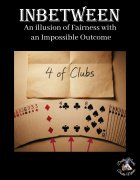
Effect: The magician writes a secret prediction and gives it to the spectators to hold. The spectators shuffle the deck. Under the fairest conditions, two spectators each look at a different card (no force) in different locations in the deck. The deck is cut by both spectators. The magician's prediction reveals the card in between the spectator's two chosen cards.
Description: The spectators never see the ending coming! This is not another prediction effect. This plays like the classic Magician in Trouble ploy.
With minimal magician involvement, a true miracle happens. Before the effect...
Faux Card To Pocket
Brick Tilley
A quick, convincing, smart version of this classic. No heavy lifting here. The vanish is clean, the action deliberate, few if any angle concerns, little skill required. Can you afford not to invest the minimal effort required to include this startling vanish/production among your surprises? You have nothing to lose and everything to gain.
1st edition 2026, video 38s.
Secret Flip
Miku W.
This project introduces three of my secret single-card reversal techniques. You can present them as a sleight demonstration or apply them within other card routines to achieve greater impact and utility. These three techniques have not been named yet.
1st edition 2026, video 7:43
Twisting Hole
Peter Pellikaan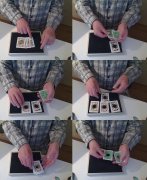
Four cards are shown and counted repeatedly. Every time through the count, one card suddenly has a big hole through its center. These are real holes you can put your finger through. This goes on until all four cards have holes.
1st edition 2026, video 2:13.
Triple Cut ACAAN
Miku W.
The spectator selects a card and replaces it in the deck. The magician has the spectator cut the deck into three piles and turn over the top card of each pile. None of them is the selection, but the values of the three top cards add up to the exact position of the selected card.
No Crimp - the position is found purely by adding the values of the three cards the spectator cuts to. There is no secret cut involved.
Performance transcript:
- Start by having the spectator freely select a card.
- Have the spectator remember the selected card.
- The spectator may choose any card in the deck. ...
Revolving Cut Four Aces Four Kings
Miku W.
A very simple way to cut to the desired cards, ideal as an opening effect. A detailed application of a classic principle, ending with an unexpected kicker.
1st edition 2026, video 4:10.
How 2 Catch 1 Card
Biagio Fasano
An impromptu location effect, incredibly self-working.
The title, which could also be read, thanks to a play on words, as "How to catch one card," indicates an easy but amazing effect, performable in any context and incredibly self-working, of finding a chosen card lost in the deck, thanks to two other cards that the magician himself will choose, inside two piles shuffled by the spectator, in order to capture it in a way that is as simple as it is unexpected...
Strengths:
- The effect is completely automatic and impromptu.
- The magician does not necessarily need to know any card manipulation...
Edward Marlo's Full Tilt
Jon Racherbaumer
There was a time when the Tilt, or Depth Illusion, was a top-secret technique known only to a few select insiders. The history of this move is somewhat murky, but most credit Dai Vernon with its invention. Marlo claimed he came up with it independently, which I find plausible. Regardless of who first had the idea, the Tilt is a wonderful deception. Over the years, refinements and subtleties have been added by several cardmen. Today, the Tilt is one of the core techniques most card magicians have in their arsenal.
The concept of the Tilt is the following: A card is apparently...
Three Palm Ideas
Miku W.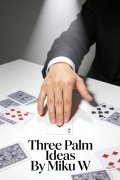
This tutorial teaches three of my palming techniques. Because my hands are relatively small, palming has always been challenging for me, which is why I developed several simpler palming methods.
Crescent Palm: a technique for palming a card quickly during the squaring of the deck.
Pinched Palm: a fast and simple bottom-card palm.
Stealing Palm: my take on the Diagonal Palm Shift, designed to move a center card directly into Classic Palm.
1st edition 2026, video 6:20.
Total Hallucination
Dustin Marks
This is not just a card trick. It's an experiment in the fallibility of human memory and perception. With one card you create a miracle!
A single card is placed on the table by the spectator. Both spectators look at the card, and yet they see different cards. The magician never touches this single card. In the spectator's mind this is a hands-off miracle.
This effect creates a moment where the spectators question their own perception and memory!
Two variations: One variation is simple with no preparation; the other version requires a two-way forcing deck, but this leads to an impossible...
The Polygraph of Twin Truths
Biagio Fasano
Two cards are chosen and revealed by the deck itself in an amazing automatic effect.
This is an amazing self-working effect revealing a pair of cards chosen by two spectators, made possible thanks to a special arrangement of the deck: a variation, unknown to most, of one of the most famous mathematical stacks... After learning a practical method for easily sequencing the deck according to this secret stack, starting with a factory-new deck, here you will find an explanation of the effect, automatic and themed "Truth Machine," which can involve two spectators.
Each of them will choose...
Page Wright's Notebook
T. Page Wright
Excerpt from the foreword by William W. Larsen:
That this is Page's notebook should be sufficient to recommend it to your study. I say "study" advisedly. A skimming of the material will not suffice. Most of the items are of an advanced nature . . . and, therein is their merit.
Table of Contents
- The Page Pass
- The Visible Pass
- The Riffle-Slip
- False Shuffle
- The Riffle-Down
- The Glimpse
- Simple Glimpse
- One of Four Packets
- A Card with a Certain Number of Pips
- The New Transferred Cards
- Any Card To Any Number
- A Cut At Any Number
- An Original Spelling Card
- The Red and...
The Gift 3
Unnamed Magician
In this PDF, I am publishing a very strong variant of my effect The Gift. I call this variant The Gift 3 - I've already published another effect called The Gift 2, hence this is the third effect in the series.
If you first watch the performance video of The Gift (using the aforementioned link) and then you watch the performance video of The Gift 3 (below), you will notice a crucial difference that makes this variant more impossible-looking. Thus, this variant is a good performance piece for those magicians who are aware of the workings behind the original The Gift...
The Hidden Alliance
Dustin Marks
Effect: After shuffling the deck, the magician turns away, while the spectator cuts the deck and deals cards face down into two piles, stopping whenever they choose. The magician then reveals the bottom card of each pile. As a kicker, the spectator selects any numbered card, and the magician tells them which card is at that position in the remaining deck. After demonstrating the procedure, the magician never touches the cards again.
Description: If you have taken the time to memorize a stacked deck but rarely put it to use, that's about to change. This effect is powerful and simple to perform....
Choice of Mortals
Miku W.
The spectator freely cuts the deck. The performer spreads the cards and claims to mentally influence the spectator to choose a specific card. The spectator then freely selects a card - no force. After the selection, the performer splits the deck at the point of selection and reveals that the cards are in suit-and-value order, except for the one card the performer named at the beginning. The finale reveals the spectator's selection, which turns out to be exactly the card predicted at the start.
- No force
- No gimmick
- Only a regular deck
Performance transcript:
- To begin, the spectator...
Dusting Off the Revolving Aces
Ian Baxter
Herb Zarrow is one of the most recognized names in magic. His Zarrow Shuffle changed the face of full deck false shuffles some seventy years ago, and its popularity shows no sign of abating. Among Herb's other memorable contributions was Revolving Aces, a knockout 'Cutting To The Aces' approach that grabbed immediate attention and saw publication several times. Perhaps the most detailed write-up was in Harry Lorayne's classic text, Close Up Card Magic.
Decades later, here is Dusting Off The Revolving Aces, a revised handling from Ian Baxter that eliminates the necessary setup...
Take a Card
unknown
These tricks were taught to US soldiers in military hospitals to keep up their spirits. They do not require any sleight of hand. Originally published by the Association of American Playing Card Manufacturers.
- Foreword
- Three Deep
- Spellbinder
- Dead Duck
- Club Sandwich
- On Tap
- Topsy-Turvy
- Plus Ten
- Two-By-Two
- Seven-Eleven
- Frying Pan
1st edition ~1950s, 21 pages; PDF 23 pages.
The BTM Stack & Dark Red Scam Bundle
Brandon Ruiz
Two items by Brandon Ruiz at a reduced price.
Dark Red Scam
Brandon Ruiz
Every glance becomes a memory.
Dark Red Scam by Brandon Ruiz is a marking system designed exclusively for serious mem-deck workers.
Instead of marking values or suits, all three systems reveal card positions only, allowing you to instantly know any card, cut, peek, or disturbance using any memorized stack (Mnemonica, Aronson, Redford, BTM, etc.).
Inside, you'll learn three distinct marking systems from fast reader-style marks to ultra invisible coded system balancing speed, invisibility, and control. Every system bends to your choice of stack, not the other way around.
Dark Red Scam...
Reversal of Change
Miku W.
A variation of a classic routine: the four Aces are turned face down one by one. The performer openly changes the orientation of all the cards, and after the audience confirms the backs are the same color, all four cards change to different colors.
1st edition 2025, video 7:39.
Royal Prophecy
Miku W.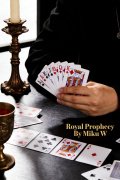
A completely self-working effect requiring no sleight of hand. The magician introduces a prediction card and has the spectator freely cut a small packet. The deck is then divided into three piles, and cards are dealt down according to a freely chosen number. The four Aces are cleanly located. In addition, the spectator's cut card, the prediction card, and the bottom cards of the three piles combine to form a Royal Flush. For the full procedure, please refer to the video demonstration.
Performance transcript:
- For this routine, I begin by taking out a prediction card.
- I place the prediction...
Double ACAAN Openly Predicted & in Any Order
Biagio Fasano
A double "Any Card At Any Number" effect, fully automatic, with a secretly ordered stack that will practically do all the work for you.
An incredible and Self-Working pair of Card Magic tricks, based on the properties of a variant, unknown to most but in any case unrecognizable to the public, derived from what is probably one of the most famous mathematical stacks... In addition to learn a practical method for building it easily, starting from a new deck, you will find two effects explained here on the theme of "Any Card At Any Number."
In the first effect, the magician will announce...
Red Black
Peter Pellikaan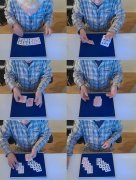
A new method for a simple oil-and-water type of routine. Nothing is gimmicked. There isn't any complicated sleight-of-hand either.
1st edition 2025, video 1:20.
Cavorting Ladies
Jon Racherbaumer
This routine illustrates the principle of synergism. After you learn it, analyze how all its parts (even the minutest) are combined into a time-and-content continuum. It's systematically designed in a progressive way: each discrete effect is successively better. There's culminative improvement and step-by-step enhancement - not only in terms of overall deception, but in virtue of its "theater."
This was the original version of what Jon later called Ladies on the Loose.
1st edition 1991, PDF 11 pages.