Cards in Magic & Mentalism: page 74
Products
Card from Handkerchief
Dustin Marks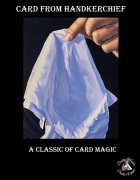
Effect: The spectator freely selects a card under the fairest of conditions. It is lost in the deck by the spectator. After placing the cards in the cardbox, it is wrapped in a handkerchief. The spectator holds the handkerchief and gives it a shake. His card falls to the table.
Description: This is a classic of card magic. Under the fairest possible conditions, a spectator selects a card from a deck that he has shuffled. The deck is placed in the cardbox and wrapped in a handkerchief. It is dropped by the spectator instead of the magician. This version uses an ungimmicked opaque handkerchief...
Hidden in Plain Sight
Mago Marko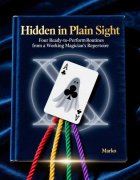
Ready-to-perform routines from a working magician's repertoire.
Hidden in Plain Sight isn't just another magic book - it's a curated collection of four battle-tested routines from Marko, a professional magician with 57 years of real-world experience. These are not theoretical curiosities or over-engineered gimmicks, but practical, powerful tricks that have fooled audiences on television, cruise ships, corporate stages, and intimate parlors across two continents. Each routine is streamlined for performance, easy to prepare, and designed to leave spectators genuinely astonished.
Whether...
Sandwiches and Collectors
Miku W.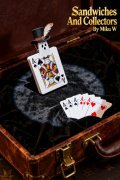
Sandwich and Collectors are two of my favorite card effects and the ones I've studied the most. This is my original routine combining both effects.
The spectator selects a card, returns it to the deck, and the deck is shuffled. The magician cuts the two Jokers and four Aces into the center. When the deck is spread again, the two Jokers are found sandwiching the spectator's selection, while the four Aces have collected the other three cards of the same value. A pure sleight-of-hand routine with no difficult moves.
Performance transcript:
- Four Aces.
- The spectator selects a card. ...
Chance vs Choice
Dustin Marks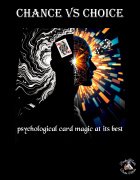
Effect: Spectator 1 shuffles the deck, takes it under the table and looks at any card. Spectator 2 just thinks of a card. The magician reveals the name of spectator #1 card and the name and position in the deck of spectator #2 thought of card!
This is the strongest effect I have ever created! An effect that dives deep into the timeless mystery of chance versus choice.
This routine combines two classic principles of magic into an amazing new weapon: a third principle that can be used with other card effects. And just when you think it can’t go further, a brand-new principle is introduced—pushing...
Aces with Artistry
Ian Baxter
Ace Assembly routines have been with us for decades. Some originate from the best brains in magic, others too numerous to mention, are utterly forgettable - lengthy, complex routines overburdened with ham-fisted false counts, lugubrious palming techniques, endless Double Lifts and quaint presentation ideas.
If you are heartily sick of these approaches, here is a routine that will grab your attention.
Aces With Artistry is just what its title implies, an Ace Assembly that stands up there with the best of them. Visually captivating, AWA owes its pedigree to Ed Marlo and is based...
The Sue Dough Centre Deal
Paul Gordon
You feign a centre deal with basic moves. You openly cut the four Kings into the deck and deal them to the spectator. But the four cards you get are the four Aces. Easy and magical! You get a bonus tutorial of Imperial Bicycles.
1st edition 2025, video 10:05.
6 Stunning Card Tricks
Ian Adair
Snow Drift Deck: A find the Lady type of effect using a deck of 52 blank cards and a Queen.
Origami Card Discovery: A strip of folded paper displays a prediction of a card which a spectator will select. It's wrong! The image magically changes, and the prediction is 100% correct.
Simplicity Card to Wallet: No special wallets used, yet the same effect is accomplished using a very simple method.
Peek-A-Boo!: A joker card, which has a corner missing, is used to locate a chosen card within a shuffled deck.
Split Down the Middle: Ian's version of the classic 'Split Deck'. The deck has...
Tracking Four Cards
Miku W.
This is a trick for quickly locating four selections.
During an overhand shuffle, four cards are freely chosen, with no control involved. The spectators clearly see the cards lost in four different positions. Yet in the end, the magician can still locate all four selections with precision. For the full routine and effect, see the video demonstration.
- No force
- No gimmick
- No memory work
- No peeking
Performance transcript:
- This is a trick for finding four selections.
- Shuffle.
- Have the spectator call stop at any point.
- Remember the stop at card.
- Continue.
- Call stop again anywhere. ...
The Deaf Dealer
Paul Gordon
Four, say, duplicate Queen of Clubs magically change to four Ace of Spades. These then change to the four Aces. It's a beauty to perform and watch.
1st edition 2025, video 8:44
Italian Lecture
Jon Racherbaumer
Jon Racherbaumer lectured around the globe. These are the lecture notes for a lecture he gave in Italy in 2008.
- Rules of the Game / Max Maven
- Snap-Slap Transpo / Marc Serin
- Supra-Gemini / John Guastaferro
- Mathematician - Psychic - Magician
- Suit Yourself / Henry Evans
- Unambiguous Discernment / Edward Marlo
- Humma-Humma-Hummer / Lewis Jones and Jack Avis
- In the Nick of Time / John Gustaferro
- The Last Game / David Britland
- Dunbury Lie Speller
1st edition 2008, PDF 28 pages.
Fifty New Card Tricks
Howard Thurston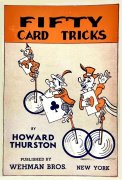
Includes a comprehensive description of the continuous front and back hand palm with cards, and the sensational new rising card trick.
Table of Contents
- CHAPTER I. A Few Incidents in the Life of Howard Thurston
- CHAPTER II. Indispensable Sleights
- THE PASS
- THE FORCE
- THE CHANGE
- THE ORDINARY PALM
- CHAPTER III. The Continuous Front and Back Hand-Palm and Tricks in Connection Therewith
- THE DISAPPEARANCE OF FIVE CARDS ONE AT A TIME
- THE PRODUCTION OF CARDS ONE AT A TIME AT THE FINGER-TIPS FROM THE BACK-HAND PALM
- THE PRODUCTION OF CARDS AT THE FINGER-TIPS FROM THE ORDINARY PALM
- PASSING...
Darned Pain in the Neck
Paul Gordon
You try to show a Four-Ace trick, but the same indifferent card keeps appearing. The kicker ending is a shocker, and it's both funny and magical.
1st edition 2025, video 12:59
Double Serch
Miku W.
The magician begins by taking out four Aces. The spectator selects one red card and one black card, which are then returned to the deck and shuffled. The spectator is asked to cut the deck randomly into four packets. The four Aces are placed on top of each packet. The packets are reassembled. When the deck is spread, the four Aces not only gather together, but the red Aces sandwich the spectator’s red selection, and the black Aces sandwich the spectator’s black selection.
- No force
- No gimmick
- Impromptu performance
Performance transcript:
- Four Aces.
- Spectator picks a black...
Collenddon Aces
Paul Gordon
The effect is pretty standard, but the sneaky method isn't. Four Aces vanish, and one is located by spelling to it. What's more, the other three magically appear. Standard sleights.
1st edition 2025, video 13:38
Three Stewart Judah Card Classics
Ian Baxter
John Northern Hilliard, in his classic text Greater Magic, made this poignant observation: "Stewart Judah looms extravagantly in the field of magic. I would rather see him do a card trick than go to a convention."
Another famous identity, Jay Marshall, editor of The New Phoenix and one of the twentieth century's most celebrated magic dealers, was equally laudatory: "Stewart Judah is the world's greatest magician!"
Similar tributes about Judah have flowed continuously over the years - perhaps helped along by his astonishing book [lp=758790 The Magic...
CAT 2 FAT: Cut and Turn to Find Any Thought
Biagio Fasano
A deck of cards is shuffled and turned over several times, responding to various "Stop!" commands given by a spectator, to determine a number and the thought of a card which is magically found in the deck. But the miracle will happen a second time, when everything will be interpreted in reverse!
The title refers to a semi-automatic effect with cards, in which the magician invites a spectator to say three different stops at three different points in the deck. For each of them, turn the deck over at the exact point of the 'Stop' and, at the end, turn the whole deck over to extract the first...
Back and Forth Aces
Miku W.
A classic routine for producing the four Aces: the magician shuffles the deck and has the spectator cut the cards. The cards at the cut are shown to be indifferent, but with just a few throws of the two packets in the magician's hands, the four Aces are easily found.
1st edition 2025, video 1:57.
Marlo's Rebound Aces
Jon Racherbaumer
In the early days of the Phoenix, issue number 12 to be exact, Lu Brent had an intriguing idea in an Ace effect titled "Together Again." In the effect, he was able to show each and every Ace being replaced into the deck, except for a chosen packet that contained, of course, the chosen Ace. At the finish, the four Aces were in the chosen pile. It used duplicate Aces. Marlo eliminated the need for duplicate aces.
- Together Again / Lu Brent
- Hindu Aces / Arthur Buckley
- Methods of Apparently Losing the Aces
- Sudden Aces
- Convincing Aces
1st edition 2025, PDF...
4 Effects
Dustin Marks
4 Brand New Effects. I have not published these effects anywhere.
- Structured Procedure and Setup: Each effect is meticulously detailed with specific setups and methods. Most setups are minimal.
- Audience Management & Psychological Play: The magician's actions, patter, and even the "illogical" elements are designed to manage spectator perception and prevent suspicion.
- Apparent Fairness: Despite the deception, the goal is often to make the trick appear as if "magic was real," minimizing suspicious movements.
- Building Impossibility: Effects are structured to eliminate perceived solutions,...
Pre-Vision of a Card at a Number
Biagio Fasano
A number, generated by the sum of the values of 5 randomly selected cards, will magically reveal the exact card predicted by the magician from the beginning!
The title refers to a semi-automatic card effect, in which the magician shuffles the deck and gives it to a spectator to cut and complete. He then hands him a pair of dice (he can also just ask him to imagine them) and, before throwing them, places a card face down on the table, announcing that it is his Pre-Vision of what will happen shortly. Once they verified the score obtained from the two dice, he stacks that exact number of cards...
10: you are magic No. 10
Father Cyprian
- Foreword
- Doctor Jekyll And Ms. Hyde
- Invisodex
- Aces - Chicago Style
- Watch Your Aces
- Watch Your Aces II
- Switchblade Aces
- Ring In Nest Of Boxes
- Ring In Nest Of Boxes - Plot
- Disposition Of Props And Method
- Card In Wallet - Props
- Disposition Of Props
- The Big Little Signed Card In The Wallet Scam
- Becker And Cyprian
- Bank Deposit Slip Prediction
- Match Box
- Addenda
1st edition 1983, 31 pages; PDF 34 pages.
Shocking Coloured Card at Number
Biagio Fasano
A series of cards, taken from four piles decided at the "Stop," are progressively eliminated, until only one pair remains to decide both a card and a number. Not only will that card be found in the deck at the number, but all the cards stacked under that pair will result magically divided by color!
Shocking Coloured Card at Number is a semi-automatic effect with cards, in which the magician shuffles the deck, then deals the cards into four separate piles, alternating between a spectator's "STOPS" and his own. Having collected the piles, he will gradually eliminate their cards until he...
Bammo Dreamcatcher
Bob Farmer
After the spectator's selection is lost in the cards (it really is), the spectator imagines (as if in a dream) his card in various scenarios (e.g., as a mirage in the desert, as a reflection in a mirror, on top of Mount Everest, etc.).
Neither the selection nor the scenarios could be known to the magician using his five senses. And the magician could not know where in the cards the selection might reside.
Using his sixth sense, the magician reads the spectator's mind and identifies each scenario the spectator has thought of.
But the chosen card's identity and its location are still...
Perfect Match
Biagio Fasano
A card, generated by pure chance, together with the precise will of a spectator, after the magician, using a special shuffle method to progressively eliminate pairs, has excluded every other card from the deck, it will be magically found.
This is a semi-automatic card effect, in which a spectator cuts the deck, shuffled by the magician, and begins to turn the cards over one by one, stopping when he wants. From that point on, the first two cards can indicate the value and suit (or vice versa, at his discretion) of a completely random card. Taking the deck back, and showing that it is neither...