Cards in Magic & Mentalism: page 68
Subtopics
Self-Working or Sleightless DIY Playing Cards Moves & Techniques ACAAN Stacks Marked Gaffed Rising & Levitating Manipulation & XCM Svengali Torn and Restored Jumbo Cards LinkingAuthors
Products
Three Daley Deceits
Ian Baxter
Doctor Jacob Daley was one of the most respected sleight-of-hand artists of the twentieth century. This acclaimed New York performer left the magic fraternity an astonishing cache of published works, from the acclaimed Stars Of Magic series to prized entries in assorted books and magazines.
Three Daley Deceits offers a new look at three of the Doctor's most celebrated card mysteries, carefully revised by Australian cardman Ian Baxter.
Daley's Aces - In Spades is Baxter's spin on this ever-popular transposition. The four Aces from the deck are slowly and deliberately placed on the table, Hearts and Diamonds...
Card Tricks for Audiences That Don't Like Cards
Sam Dalal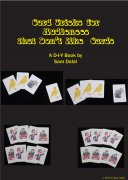
If you think packet card effects are "hot", but some of your audience don't, you should read this book. Many very good packet card effects do not find favor with some audiences. Kids don't understand playing cards. Teenagers of the fairer sex just don't "dig" card tricks (or most magic tricks for that matter). Many ladies will hide a polite yawn. As will some gentlemen when preoccupied with more "spiritual" pastimes.
But a slight twist in the tale could change their perception. And this is what this manuscript aims at. Here are your (and my) favorite packet tricks, "dressed to please"....
The SSSB Principle
Unnamed Magician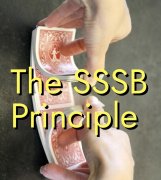
This ebook is not about any particular effect but rather is about a principle that you can apply to certain types of effects in order to double their fool factor. The principle makes it possible to create the illusion of a shuffle where a shuffle wouldn't otherwise be possible. There are many effects in which the deck can only be cut at the end (not shuffled). With the application of this principle, you can create the illusion of a shuffle. Best of all, the illusion can be created with the spectator themself shuffling.
That's not to say this principle can be applied to just any effect....
Wild Card Variations
Sam Dalal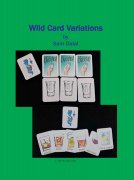
The Wild Card effect has been one of my favorite packet effects from as far back as I can remember and is indisputably one of the best card packet effects of all time. Unfortunately, in its original form, it does not meet my concept of good magic. It does not answer the basic audience dilemma - "Why does he do it ?"
I know transformations (anything that changes) are part of a magic effect, but there ought to be some reason for it. If a performer changes blank paper to currency notes, that's logical, it's something everyone in the audience would like to do. If he changes a silk to an egg,...
Impromptu Card Tricks
Mago Marko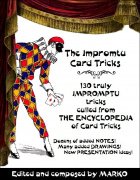
In this fantastic ebook, you'll find the truly impromptu tricks found in The Encyclopedia of Card Tricks, together with dozens of notes not found in the original. These notes add new and interesting tricks and fresh ideas for presentation and even patter in some instances. But that's not all. We have added many illustrations that help clarify the description of certain tricks. Another thing we have done is adding, in some cases, the original advertisements that were used to sell these tricks when they were put on sale way back then.
Truly impromptu means that you take a normal shuffled deck and immediately, with no preparation...
Cardwitched
Shaun Yee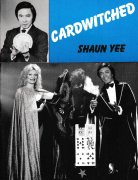
Excerpt from the foreword:
This is my second book on visual card magic. Like my other book Cards in Action, this book contains completely original sleights, routines and my own handling of some well-known effects.
You will find that most of the material is not too difficult to do, as in most of my card work, I usually employ sleights which are easy and angle-proof. Of course, practise is necessary in order to perform the feats smoothly, faultlessly, and convincingly. Good things never do seem to come easy.
I have included many of my "gems", and I am, of course, justly proud of my creations and...
Cards in Action
Shaun Yee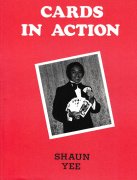
Excerpt from the introduction:
This is a book on card magic. It is not for the all-thumbs newcomer as the effects and routines contained herein require the ability to execute smoothly, various sneaky sleights such as the deceptive buckle-count, the convincing false-shuffle, the confusing multiple-cut, the quiet side-steal, the casual double-lift and so on.
Though this book deals primarily with sleight-of-hand effects and routines, a really effective magical programme of card entertainment should be well-balanced with sleight-of-hand tricks and one or two non-sleight effects. By the latter,...
Colour Confusion
Mark Leveridge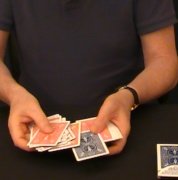
A blue-backed deck is openly displayed and one card is selected from the face-down deck. Cutting the selection back into the pack and shuffling the deck, the performer offers to find the selection quickly and effectively.
Snapping his fingers over the deck, he turns the cards face down and spreads through the entire deck to reveal that every card back has changed from blue to red, except for just one card, and that turns out to be the selected card!
No sleight of hand is required, this is designed to instantly re-set in front of the spectators and everything takes place up in your hands,...
Fifteen Star Card Effects
Lu Brent
Fifteen excellent pasteboard effects, all easy to perform, as they require little or no skill.
The contents include "Unbelievable Coincidence" which in itself is worth more than the price of the entire book; "U-Find-Our-Cards," a chapter wherein spectators unknowingly discover their own selected cards in a puzzling fashion; and "Auto-Graphic Minds," which will never fail to bewilder the closest observer. Plus additional tricks of a professional caliber.
Here is a collection of the very smartest magic, devised and used in his own act by Lu Brent, the top-notch Philadelphia professional...
Thirty
Ray Grismer
Cards across
The Thirty Card Trick is a magical classic that can be done on stage as well as close up. It is entertaining to all types of audiences. The classic method (Magicians' Tricks by Hatton and Plate) used sleight of hand and math chicanery. Zens used envelopes. Crandall used roughing fluid. You should find this method one of the best because instead of making the passing of three cards an arbitrary choice it offers a logical reason for using three. Also, there is very strong misdirection. Each step is clearly explained along with the reasoning.
The moves are well covered by misdirection and by having unbalanced...
3 Card Con
Mark Leveridge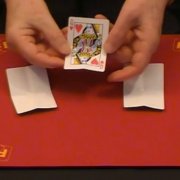
Three pre-folded cards are tipped from a card box and displayed as being a QH and two blank cards. The three cards are folded to conceal their faces and arranged in a row on the table ready for the classic Find The Lady. Having mixed the positions of the three cards, the one that should be the QH is opened to reveal it is in fact one of the blanks. That’s surprise no. 1. Surprise no. 2 comes when the other two cards are unfolded to reveal they are both blanks as well! The QH has completely disappeared. Surprise no. 3 is revealed when the QH is found folded inside the card box that has been...
Vanishing at the Royal Court
Biagio Fasano
An incredible impromptu effect that uses all court cards in the deck to tell a story dense with mysteries.
This is a packet trick that tells the magical solution to a mystery. An impromptu card effect that, borrowing all the pictures from the deck, uses those to tell the story of a mysterious disappearance at a prestigious dance party reserved for these four aristocratic families.
The illusionist, after shuffling the twelve cards, gives them to cut and complete to a spectator who then, by rolling two dice (even if only imaginary ones) decides the precise moment when the mysterious vanishing...
Glaces
Ray Grismer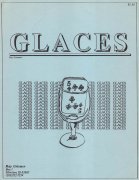
This effect was invented by Herbert Milton and made popular by Karl Germain. The improved method needs no double-faced cards and can be done impromptu providing the right type of glass is available. This visual effect can be performed at any time in your act and it may be done silently, with talk, or to music.
EFFECT: A shuffled deck of cards is placed in a stem goblet. Each time a handkerchief is flicked in front of the glass an ace appears.
This is Ray's totally impromptu method for a classic effect - one that has recently found favor with a number of well-heeled modern performers....
Three Rapid Spellers
Ian Baxter
To all magicians, amateur and professional - here is a loaded question:
Have you ever been bored silly watching a magician perform a spelling trick?
This is contentious and very obviously axiomatic. Quoting from the Preface of his new manuscript, Australian card man Ian Baxter comments: "Unfortunately, spelling effects in card magic hold the onerous title of being the most laborious, boring presentations imaginable."
This is the point at issue - boredom setting in, thanks to the tedium of endless counting and spelling, usually propped up with trivial patter. Such effects are simply...
Take a Card
Jack McMillen & Judson Brown
This hard-to-find book of eleven clever card effects was ahead of its time and still plays well to today's audiences. While not self-working, magicians with ordinary card ability can do them all.
The effects include:
- An Instantaneous Detection
- The Haunted Whisper
- The Hazy Pips
- From Another Deck
- A Joker Location
- Another Joker Location
- Blowing the Pips
- A New Reverse Location
- Upside Down
- The Phantom Pips
- Topsy-Turvy Location
Acclaimed by close-up masters including Dai Vernon and Charlie Miller, McMillen and Brown were known as the most skillful card performers on the Pacific coast. Those who knew...
Scripted #40: Bigger and Better
Larry Brodahl
A more magical version of the trick "Bigger" found in the Mark Wilson Course in Magic
A paper bag gets inspected, and 3 cards are chosen and put on display on the volunteer's body. A different deck is shuffled and dropped into the paper bag, and the spectator shakes the bag to shuffle the cards. Reaching into the bag, and without looking, 2 of the matching cards are found. The third card – the bigger card - is found because it is a jumbo card.
A little arts and crafts are required.
1st edition 2024, PDF 24 pages.
Bammo Strange Attraction The Sequel
Bob Farmer
Time to open a can of whoop ass!
The business card of the fortune teller Madame Magdelaine De La Grange has been torn in two. The spectator retains one piece. The other piece vanishes and appears stuck to the back of the spectator's selected card. The piece retained by the spectator matches the piece on the card perfectly.
A bizarre effect without precedent.
No palming. No angles. Resets automatically. You will need a Himber or Z-fold wallet.
1st edition 2024, PDF 12 pages.
Cards in Cabaret
Ken de Courcy
From the prologue by Billy McComb:
The thing which annoys me about Ken de Courcy is that he has a tidy mind. This means he correlates everything in his nut so that it all has a place. This I don't have. So I suppose my annoyance is goaded by envy.
Now if you were to ask me to give you a hundred commercial card tricks which were new to audiences, I'd swallow down the Six Card Repeat and the Brainwave Deck and die quietly.
Not so our gallant Ken de C. He just sits down and puts a gaggle of highly commercial card tricks into book form ... and readably so, too. And, blast me thumb-tips, he invents...
MINT 1973 - 1974 Annotated
Edward Marlo & Wesley James
The Annotated M.I.N.T. series continues. Thanks to Ed Marlo and Wesley James, M.I.N.T III, IV, V, VI, and Annotated M.I.N.T. 1963 - 1972 are already available. After releasing M.I.N.T III through VI, and Annotated M.I.N.T 1963, 64, 65, 66, 67, and 68, then 1969-1972, the articles in this volume again depart. It includes the years 1973-1974 - comprised of fewer articles but longer and more in-depth. As Wesley progressed toward completing the full run of Marlo In New Tops material, plus his extensive annotations, observations, and Bonus material, he wanted to be fair to Marlo fans, and to his...
Bammo Strange Attraction
Bob Farmer
If you're looking for a unique and quirky effect, Bammo Strange Attraction will fill the bill. A fortune teller's business card vanishes and appears attached to the back of a selected card (regular cards or Tarot cards). The manuscript includes the fortune teller's business card so you can print it out and use it for this and other effects. An additional routine by David Britland adds something seldom seen in psychic effects: a sense of humor. The routine requires a Himber or Z-Fold wallet.
1st edition 2024, PDF 11 pages.
Quicker Quest
Ian Baxter
A new approach to the Stewart James classic Queer Quest.
Another Stewart James card mystery from the past, brought right up to date by Australian cardman Ian Baxter.
Queer Quest first appeared in The Jinx magazine back in 1938. Publisher Ted Annemann endorsed it immediately because this was obviously not just another card trick. Although the effect is far from new, three spectators each selecting a card with the performer locating them one at a time, Queer Quest stood out because of its simple method and straightforward presentation.
Eighty-five years down the track and Q.Q. is now totally revamped, with easier handling...
Card Sharping Exposed
Jean Eugene Robert-Houdin & Professor Hoffmann
A translation of Les Trickeries des Grecs by M. Robert-Houdin, one of the most valuable and interesting works on the subject of card sharping.
Excerpt from the preface:
Meanwhile, the march of science has continued, and the arts of deception, like other arts, have received many new developments. There are fashions in fraud, as in more innocent matters. I have endeavoured in the present pages not only to offer a faithful translation of Robert-Houdin's text, but by the aid of notes to bring down his work, so to speak, to present date. In so doing I have to acknowledge special obligation...
Shenanigans
Liam Montier
Note: In order to perform these tricks you will need some standard bicycle gaffs.
Originally available only as a limited edition booklet, Shenanigans was a complete sell-out at Blackpool Convention a few years back. In it are the full explanations of three of Liam's most commercial routines. These aren't for the 'move monkeys', these tricks are for those who like to get out and actually do the magic for their friends, or for their profession.
IN3D
"This is a shockingly cool trick. Plays so strongly to a large crowd or amongst friends. It's just a brilliant trick and in the current...
Griff on Cards
Tony Griffith
Prize-winning card magic without skill.
Here's an ebook brimming over with new and original card tricks all performed without skill. Startling, practical magic that you will enjoy working with. Novel mysteries from a great close-up worker who believes that the simple way of performing magic is the best way. Dozens of expertly drawn illustrations by artist John Dyke. All items are clearly and concisely described, and easy to follow. Only one sleight is used, once, in the whole of the book.
A Demonstration on How to win at Poker
The trick that won the Cecil Lyle award. A tremendous routine...